Not the end after allNippon Budokan
The Tigers' farewell concert at the Nippon Budokan, January 24, 1971
On January 24, 1971, The Tigers, the biggest name of Japan's late-1960s Group Sounds boom, ended four years as a band with The Tigers Beautiful Concert at the Nippon Budokan in Tokyo. It is described as the first solo concert a Japanese music group ever gave at the Budokan. Five years earlier, before their debut, the members had sat in the same hall to watch the Beatles. The night opened with an announcement in English. A first part built on Western covers, starting with the Rolling Stones' "Time Is on My Side," gave way to a second part of their own hits, "Boku no Marī," "Seaside Bound," "Hana no Kubikazari" and more, 37 songs in all by one account. Late in the show, Taro Morimoto and Kenji Sawada broke down in tears singing "Aoi Tori," and the last song was "Love Love Love." That morning, the drummer, Minoru Hitomi, had driven to the Budokan with his belongings loaded on a truck. After the party that followed, he drove straight through the night back to Kyoto. It was not the end of the name. After a "class reunion" in the early 1980s, all five original members, Hitomi included, came together again in 2013 for the first time in 44 years and closed a reunion tour at Tokyo Dome on December 27.
Performance data
| Date | [4][5][9][14] |
|---|---|
| Venue | Nippon Budokan (Tokyo) |
| Event | The Tigers Beautiful Concert (ザ・タイガース ビューティフル・コンサート) [9][11][14][16] |
| Category | Not the end after all |
| Why it ended | Breakup [11][9][19][6] |
| Lineup | Kenji Sawada, Taro Morimoto, Osami Kishibe, Minoru Hitomi, Shiro Kishibe [4][19][1] |
| Attendance | UnverifiedNo official or contemporary figure for the attendance was found. |
| Last song performed | ラヴ・ラヴ・ラヴ “Love Love Love” [8][14][15] |
| Songs performed | 37 songsSee the setlist ↓ |
| Video release | Yes [14][8] |
About the artist
The Tigers began in Kyoto in 1965 as Sally and the Playboys, with Minoru Hitomi, Osami Kishibe, Taro Morimoto and Katsumi Kahashi[1]. Kenji Sawada joined early in 1966 and the band became the Funnys[2]. Hitomi recalls that in those days they played nothing but Western songs; prize money of 50,000 yen from a rock band contest paid for the khaki military-style outfits they would later wear on the cover of their first single[3]. They drew crowds at Nanba Ichiban, a jazz café in Osaka, and by 1966 were the top Group Sounds act in the Kansai region[2]. That same year, before their debut, they were in the audience at the Beatles' Budokan concerts[4][5].
The rock singer Yuya Uchida spotted them in Osaka[6] and brought them to Tokyo[2]. In November 1966 they signed with Watanabe Production and left Kyoto, seen off by some fifty fans on the bullet-train platform[3]. Because they came from the Kansai region, they were named The Tigers[1].
Their debut single, "Boku no Marī" ("my Marie"), written by Jun Hashimoto and Koichi Sugiyama, came out on Polydor on February 5, 1967[7]. According to the critic Takanori Chujo, it made little impact, but "Seaside Bound" in May was a hit with claimed sales of 500,000, followed by "Monariza no Hohoemi" (August 1967), "Kimi dake ni Ai o" (January 1968) and "Ginga no Romansu / Hana no Kubikazari" (March 1968)[2]. Hitomi credits their success to vocal harmonies that stood out among Group Sounds bands; in 1968 he appeared on the cover of the monthly magazine Myōjō six times, and Sawada four[3]. The writer Katsumi Koizumi notes that TV shows such as Shabondama Holiday spread their popularity, and that hits like "Shī Shī Shī" put them at the top of the Group Sounds boom in 1968[1]. They starred in the science-fiction film The Tigers: Sekai wa Bokura o Matteiru (1968), a romance with a princess from the Andromeda galaxy[2]. Their first album, The Tigers On Stage, recorded at a recital at Sankei Hall in Tokyo on August 22, 1967, reached No. 3[8].
Popularity did not mean respectability. Hideki Take, a critic who has covered Japanese pop for decades, writes that Group Sounds bands faced limits on appearing on the public broadcaster NHK and hostility from school boards and schools[4].
Why this was thought to be the end
The first crack came in March 1969, when the lead guitarist and singer Katsumi Kahashi left[1][9]. Koizumi places his departure amid the members' growing frustration with being marketed as idols[1]. Taro Morimoto remembers differences of opinion opening up within the band[9]. For Minoru Hitomi, who had assumed the five would always stay together and who heard Kahashi's high voice as the core of their sound, it felt like a dream collapsing[3]. Kahashi's replacement was Shiro Kishibe, called back from the United States[1], the younger brother of the band's leader, Osami Kishibe[5][10].
Hitomi thought about quitting too. He asked the novelist Renzaburo Shibata for advice and was asked what he would do next. When he said he wanted to go back to the studies he had neglected, Shibata pointed out that studying takes money. With no savings, Hitomi asked Watanabe Production to let him stay one more year[3]. As Morimoto remembers it, the management persuaded Hitomi to postpone his exit, and the breakup was pushed back by a year; that extra year, he says, is what made a farewell concert at the Budokan possible[9].
The boom itself was fading. Take writes that by around 1969 the decline of Group Sounds was already visible[4]. Morimoto says that as bands with falling sales broke up one after another, he sensed that once you start going downhill there is no coming back, and that their own time was near[9]. According to Chujo, the discord continued into 1970, Hitomi announced he would leave show business, and by May a breakup had become the band's settled course[11].
Even so, 1970 was not idle. The July single "Subarashii Ryokō" ("a wonderful journey") was Kenji Sawada's first composition[11]. Their recital at Den-en Colosseum on August 22, with Hiroshi Kamayatsu guesting on vocals and organ for part of the show, became the double live album The Tigers Sounds in Colosseum[8]; Morimoto remembers it vividly because playing without a lead guitarist was so hard[9]. The album Jiyū to Akogare to Yūjō followed on December 15[12]. The farewell concert was set for the Nippon Budokan on January 24, 1971[9][11]. The exact date and form of the formal breakup announcement could not be confirmed in the sources checked for this article.
What is known about the day
The Nippon Budokan was where the Beatles had played in 1966, with the future Tigers in the audience[5][4]. Five years later, The Tigers Beautiful Concert on January 24, 1971, is described as the first solo concert by a Japanese music group at the hall[13][4]. On stage were Kenji Sawada, Taro Morimoto, Osami Kishibe, Minoru Hitomi and Shiro Kishibe; their average age, Hideki Take notes, was 23[4].
That morning Hitomi loaded all his household belongings onto a two-ton truck and drove it to the Budokan[3]. The radio station Nippon Broadcasting carried the concert live for three hours[8]. According to Rolling Stone Japan, the crowd was overwhelmingly female[5].
The show opened with an announcement in English: "Ladies and Gentlemen, Boys and Girls," then "Say after me, TIGERS." The audience, Rolling Stone Japan writes, was left blank-faced, probably because few of them had ever been addressed in English[5]. Take sees the puzzled mood in the hall as a sign of the times[4].
The first song was the Rolling Stones' "Time Is on My Side"[4][5], a choice in which Rolling Stone Japan reads a point of pride[5]. According to Hideyuki Suzuki of the web magazine WebVANDA, the first part was built from songs that nodded to the rock scene of the day and familiar Western covers; his list has 16 songs, among them "Susie Q," "Honky Tonk Women" and "Gimme Shelter," ending with "Heartbreaker"[8].
The second part turned to recent originals and the hits. It opened with "Tokai" ("the city")[8] and ran through the singles from the debut on, "Boku no Marī," "Seaside Bound," "Monariza no Hohoemi" and "Hana no Kubikazari"[8][14]. During "Boku no Marī," it is the leader, Osami Kishibe, who talks to the audience[5].
Near the end, Morimoto and Sawada sang "Aoi Tori" ("blue bird"), the first song Morimoto ever wrote. Morimoto recalls that the feeling that this was the end, that he would never see the others like this again, welled up slowly until tears stopped him from singing; Sawada, too, was close to tears. The others were playing and singing as if pouring everything they felt into the music, and watching them, Morimoto thought: this is the end of my youth[9].
On Herman's Hermits' "I Understand," Take writes, Sawada sang through tears, adding spoken words of his own[4]. The last song was "Love Love Love." It closes Suzuki's list, and the official live album and the official footage both end with it[8][15][14]. By Suzuki's count, the band played 37 songs that night[8].
Afterward Hitomi went to the party hosted by Yuya Uchida, with the truck parked right outside. He said goodbye to his bandmates, told them they would never meet again, and left. He drove through the night to Kyoto, determined, he says, to cut his ties with show business[3]. The concert was shown on Fuji TV six days later, on January 30[8].
What the show left behind
Less than a month after the split, on February 20, 1971, The Tigers Sounds in Colosseum came out and reached No. 3, which WebVANDA notes was the band's highest album chart position. The Budokan recording followed on July 10 as the LP The Tigers Finale, which reached No. 10[8]. Rolling Stone Japan presents it as the first Budokan live album in Japanese rock history[5], though Suzuki points out that much of the show was cut[8]. The current 2013 SHM-CD has 17 songs[15][16], and a download followed in 2024[17]. Twenty-two songs of concert footage are on Disc 2 of the 2013 DVD box The Tigers Forever DVD Box: Live & More[14].
Take writes that while most bands of the era simply faded away, The Tigers were probably the only one to go out with a proper finale[4].
The five went separate ways. In February 1971 Osami Kishibe formed the rock band PYG with Sawada and others[11]. Sawada made his solo debut with the single "Kimi o Nosete" on November 1, 1971[18] and went on to a long run of hits; Osami Kishibe, later known as Ittoku Kishibe, and Shiro Kishibe became familiar as actors and TV personalities[19]. Hitomi left show business, went back to high school, studied Chinese literature at Keio University through graduate school, and taught Chinese and classical Chinese at Keio Senior High School until he retired in 2010[3].
The name came back a decade later. From 1981 to 1983 the members worked together again, framed as a "class reunion" rather than a reunion of the band; Hitomi, then keeping his distance from show business, did not take part[19]. On March 17, 1982, they played the Nippon Budokan again at the reunion concert THE TIGERS A-LIVE[14] and released three reunion singles, "Jūnen Romansu," "Irotsuki no Onna de Ite Kure yo" and "Ginga Ryokō"[20].
In 2011 Hitomi returned to music[3][19]. According to Chujo, Kahashi did not join a reunion then, so for 2011-12 the other members joined Sawada's solo tour instead, a "nearly Tigers" arrangement[19]. On the tour's final night, January 24, 2012, at the Nippon Budokan, Shiro Kishibe came too, and five of them stood together on the same date and in the same hall as the farewell concert, 41 years on[10].
Then, in 2013, all five original members, Kahashi included, came together as The Tigers for the first time in 44 years[6][21]. The tour opened at the Nippon Budokan on December 3 and ran through Nagasaki, Fukuoka, Nagoya, Kyocera Dome Osaka, Sendai and Sapporo to Tokyo Dome on December 27, eight shows in all[19], drawing about 100,000 people. In Osaka, Ittoku Kishibe told the crowd that for the five who had played at Nanba Ichiban to go their separate ways and then play together again in such a huge place was a "miracle"[21]. At Tokyo Dome, 45,000 people saw Shiro Kishibe join them, putting all six on stage[22][21]. The show was released on DVD as THE TIGERS 2013 LIVE in TOKYO DOME[22][23]. Asked about the future, the members gave mixed answers, from getting together now and then to never again[21].
Shiro Kishibe died of acute heart failure caused by dilated cardiomyopathy on August 28, 2020, at 71[24].
At the end of 2025, Morimoto, then 79, talked about the tears that stopped him during "Aoi Tori" at the Budokan[9]. Early in 2026, Hitomi, also 79, looked back on his parting words that night: in the end, he noted, he had returned to show business himself[3]. The footage of "Love Love Love," the last song of January 24, 1971, is on the DVD box released to mark the 2013 reunion[14].
Context for readers
Group Sounds. "Group Sounds" (GS) was the name for the wave of Japanese guitar bands of the late 1960s, inspired by the Beatles, the Rolling Stones and R&B, whose records were largely pop songs written by professional songwriters[19][4]. Signs of decline were visible by around 1969[4].
Watanabe Production. The Tokyo talent agency that signed The Tigers in November 1966[3].
Nippon Budokan. A large hall in central Tokyo where the Beatles played in 1966[5]. The Tigers' farewell is described as the first solo concert there by a Japanese music group, and Hideki Saijo became the first Japanese solo singer to headline it in 1975[13].
Names. Japanese names in this article are given in Western order (given name first). The members were known by nicknames: Julie (Kenji Sawada), Sally (Osami Kishibe), Toppo (Katsumi Kahashi), Taro (Taro Morimoto) and Pee (Minoru Hitomi)[23]. Osami Kishibe later took the name Ittoku Kishibe.
Watch / buyPR
We may earn a commission if you buy through these links. Details
ザ・タイガース・フィナーレ(SHM-CD)
The live album of the January 24, 1971, farewell concert (first issued on LP on July 10, 1971). The CD has 17 songs; according to WebVANDA, much of the 37-song show was cut. The same 17 tracks have been available as a download since October 2, 2024 (OTOTOY).
ザ・タイガース フォーエヴァー DVD BOX -ライヴ&モア-
Disc 2 of this five-DVD box, The Tigers Recital: Beautiful Concert, has 22 songs from this show (Universal Music). A limited re-pressing of the November 27, 2013, box; no new stock could be confirmed, so no purchase link is given.
Related releases

ゴールデン☆ベスト ザ・タイガース
A singles collection with the songs mentioned in the article, from "Boku no Marī" to the 1980s reunion singles.

ヒューマン・ルネッサンス(SHM-CD)
The 1968 album with "Aoi Tori," mentioned in the article (2013 remastered SHM-CD).
Supported by Rakuten Developers
Setlist
37 songs Unverified[8][14][15]Main set Cover Last song
- タイム・イズ・オン・マイ・サイド “Time Is on My Side”
- スージーQ “Susie Q”
- アイ・プット・ア・スペル・オン・ユー “I Put a Spell on You”
- 青春の光と影 “Seishun no Hikari to Kage” (the light and shadow of youth)
- ドック・オブ・ザ・ベイ “Dock of the Bay”
- イエロー・リバー “Yellow River”
- ヘンリー8世君 “Henrī Hassei-kun” (a Japanese title for "I'm Henry the Eighth, I Am")
- ホンキー・トンク・ウイメン “Honky Tonk Women”
- コットン・フィールズ “Cotton Fields”
- ラレーニア “Lalena”
- ヘイ・ジュテーム “Hei Jutēmu” (WebVANDA gives the original as "Mon Cinema")
- ギミー・シェルター “Gimme Shelter”
- あの娘のレター “Ano Ko no Retā” (a Japanese title for "The Letter")
- 光ある限り “Hikari Aru Kagiri” (a Japanese title for "Long As I Can See the Light")
- エニーバディズ・アンサー “Anybody's Answer”
- ハートブレイカー “Heartbreaker”
- 都会 “Tokai” (the city)
- 白い街 “Shiroi Machi” (white town)
- どうにかなるさ “Dō ni ka Naru sa” (it'll work out somehow)
- 出発のほかに何がある “Shuppatsu no Hoka ni Nani ga Aru” (what is there but setting out)
- 友情 “Yūjō” (friendship)
- 世界はまわる “Sekai wa Mawaru” (the world turns)
- 僕のマリー “Boku no Marī” (my Marie)
- シーサイド・バウンド “Seaside Bound”
- モナリザの微笑 “Monariza no Hohoemi” (the Mona Lisa's smile)
- 花の首飾り “Hana no Kubikazari” (a necklace of flowers)
- 青い鳥 “Aoi Tori” (blue bird)
- 銀河のロマンス “Ginga no Romansu” (galactic romance)
- スマイル・フォー・ミー “Smile for Me”
- 淋しい雨 “Sabishii Ame” (lonely rain)
- 君だけに愛を “Kimi dake ni Ai o” (love only for you)
- 美しき愛の掟 “Utsukushiki Ai no Okite” (the beautiful rule of love)
- 素晴しい旅行 “Subarashii Ryokō” (a wonderful journey)
- 怒りの鐘を鳴らせ “Ikari no Kane o Narase” (ring the bell of anger)
- 誓いの明日 “Chikai no Ashita” (the tomorrow we swore to)
- アイ・アンダスタンド “I Understand”
- ラヴ・ラヴ・ラヴ “Love Love Love”
Another final curtain
More “last” shows that turned out not to be the last.
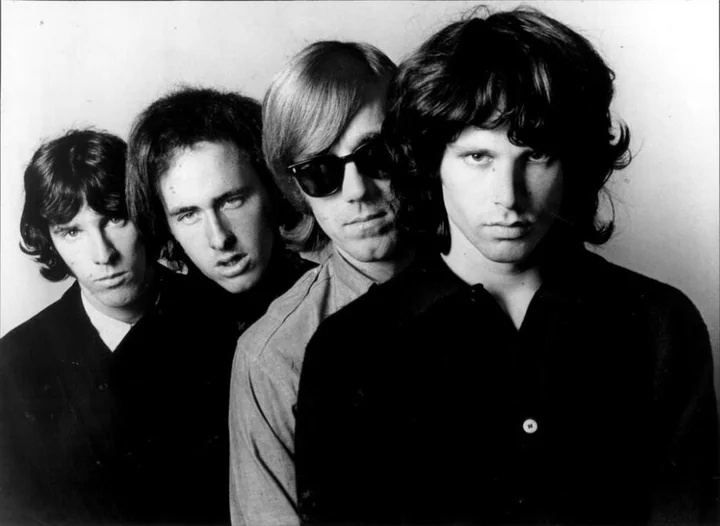 Photo: Joel Brodsky (Elektra Records) / Public Domain (US, published before 1978 without notice)
· The Warehouse
 The Doors
' last show with Jim Morrison: The Warehouse, New Orleans, December 12, 1970
Last song performed “The End”
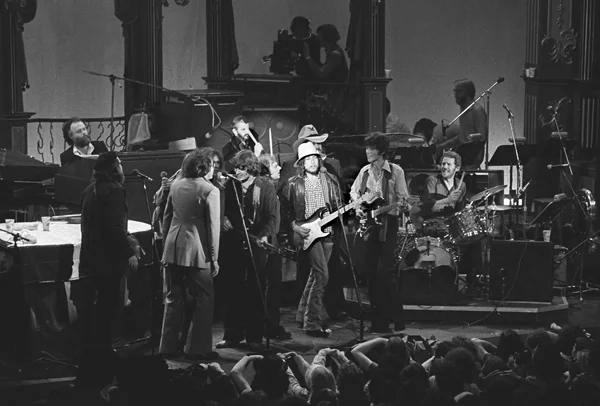 Photo: David Gans / CC BY-SA 2.0
· Winterland Ballroom
 The Band
's The Last Waltz: farewell concert at Winterland, San Francisco, November 25, 1976
Last song performed “Don't Do It”
- Active years (February 5, 1967 – January 24, 1971)
- Final show
- Osami Kishibe forms the rock band PYG with Kenji Sawada and others.
- The double live album The Tigers Sounds in Colosseum, recorded at Den-en Colosseum on August 22, 1970, is released and reaches No. 3.
- The farewell concert is released as the live album The Tigers Finale (LP, MR-5004), reaching No. 10.
- Kenji Sawada makes his solo debut with the single "Kimi o Nosete."
- The members other than Minoru Hitomi regroup under the name of a "class reunion" (through 1983), releasing the reunion singles "Jūnen Romansu," "Irotsuki no Onna de Ite Kure yo" and "Ginga Ryokō."10 years later
- Reunion concert THE TIGERS A-LIVE at the Nippon Budokan.11 years later
- Minoru Hitomi retires from Keio Senior High School, where he taught Chinese and classical Chinese; he returns to music in 2011.39 years later
- On the last night of Kenji Sawada's tour, at the Nippon Budokan, guests Ittoku (Osami) Kishibe, Taro Morimoto and Minoru Hitomi are joined by Shiro Kishibe, on the same date and in the same hall as the farewell concert. Not billed as The Tigers.41 years later
- Seven albums, including The Tigers Finale, are reissued as remastered SHM-CDs.42 years later
- The five original members reunite for the first time in 44 years and open a reunion tour at the Nippon Budokan (eight shows, about 100,000 people).42 years later
- The tour ends at Tokyo Dome before 45,000 people; Shiro Kishibe also appears, putting all six on stage.42 years later
- The complete Tokyo Dome show is released on DVD as THE TIGERS 2013 LIVE in TOKYO DOME.43 years later
- Shiro Kishibe dies at 71.49 years later
- The Tigers Forever DVD Box: Live & More (2013), with 22 songs filmed at the farewell concert, is pressed again in a limited run.49 years later
- The Tigers Finale becomes available as a download.53 years later
Sources
26 sources
- 岸部四郎、マモル・マヌーともに71歳の死…「GSブーム」とは何だったのか — 現代ビジネス(文:小泉カツミ), September 24, 2020
- 沢田研二入門(1)1965年~1968年 — All About(中将タカノリ)
- 【ザ・タイガース】旋風のその先に。別れの裏にあった、知られざる物語[79歳・瞳みのるさんのターニングポイント#2] — ゆうゆうtime(主婦の友社、文:藤岡眞澄), January 18, 2026
- ザ・タイガース「フィナーレ」 バンド少年たちの真実の姿 — J-CAST トレンド(文:田家秀樹), September 29, 2020
- ザ・チェッカーズとザ・タイガースの解散ライブアルバムから考えるアイドル性と音楽性 — Rolling Stone Japan, June 29, 2020
- 鉄人ジュリーの「六甲おろし」 — デイリースポーツ online, October 31, 2013
- ご存知ですか? きょう2月5日はザ・タイガース「僕のマリー」でデビューの日 — 文春オンライン(文:近藤正高), 2017
- 1970年代アイドルのライヴ・アルバム(沢田研二・バンド編 Tigers期) — WebVANDA(文:鈴木英之), March 1, 2020
- ザ・タイガース武道館解散の日。僕も沢田も涙で歌った『青い鳥』【79歳・森本太郎さんのターニングポイント#3】 — ゆうゆうtime(主婦の友社、文:藤岡眞澄), December 21, 2025
- 岸部四郎さん死去、兄・岸部一徳が語っていた「弟への思い」と「あの一夜」 — 週刊女性PRIME, September 16, 2020
- 沢田研二入門(3)1970年~1971年 — All About(中将タカノリ)
- 伝説のバンド、ザ・タイガース ~復活公演に先がけ、オリジナル・アルバムなど7作品が最新デジタルリマスタリングSHM-CD仕様で新登場! — ランランエンタメ!, 2013
- 【日本武道館の歴史】SMAPが1日でこなした公演数がすごい! 矢沢永吉ライブ音源もお届け — radiko news(J-WAVE), September 4, 2019
- ザ・タイガース フォーエヴァー DVD BOX -ライヴ&モア-(UPBY-9006/10) — ユニバーサル ミュージック ジャパン, December 23, 2020
- ザ・タイガース/ザ・タイガース・フィナーレ(SHM-CD、UPCY-6705) — タワーレコード, May 29, 2013
- ザ・タイガース / ザ・タイガース・フィナーレ [SHM-CD] — CDJournal, May 29, 2013
- ザ・タイガース・フィナーレ [ Live At 日本武道館 / 1971 ] — OTOTOY, October 2, 2024
- 沢田研二、TBSテレビ出演貴重映像をDVD BOXでリリース — Billboard JAPAN, February 26, 2021
- 2013年 ザ・タイガース再結成を見逃すな!42年の紆余曲折の末にあった奇跡 — All About(中将タカノリ), 2013
- ゴールデン☆ベスト ザ・タイガース(UICZ-6033) — ユニバーサル ミュージック ジャパン, November 26, 2003
- 44年ぶり!ザ・タイガース2013ツアーレポート — All About(中将タカノリ), 2013
- ザ・タイガースのオリジナルメンバー5人が44年ぶりに集結、ライヴDVD『THE TIGERS 2013 LIVE in TOKYO DOME』が発売 — amass, April 16, 2014
- The Tigers 2013 live in Tokyo Dome : Toppo, Sally, Julie, Pee, Taro(COLO-91312) — CiNii Books(国立情報学研究所)
- 岸部四郎さん死去 71歳 急性心不全で 西遊記・沙悟浄役などで人気 — デイリースポーツ online, September 15, 2020
- ザ・タイガース「ザ・タイガース・フィナーレ」(UPCY-6705) — Billboard JAPAN, May 29, 2013
- ザ・タイガース — Wikipedia 日本語版
Revision history
- Page created
 Sex Pistols
 Pink Lady