Not the end after allWinterland Ballroom
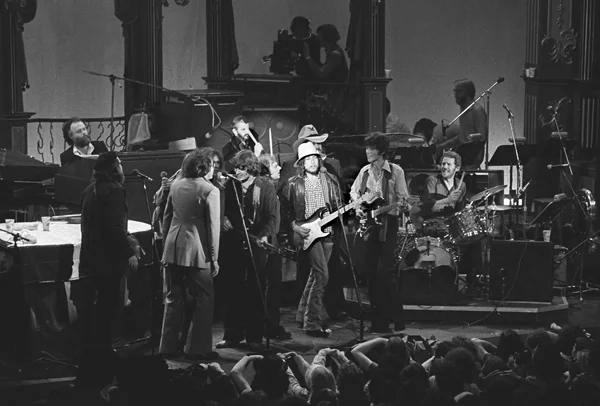
The Band's The Last Waltz: farewell concert at Winterland, San Francisco, November 25, 1976
On Thanksgiving Day, November 25, 1976, the Band said goodbye to the road with a concert they called The Last Waltz, at the Winterland Ballroom in San Francisco. Some 5,000 people paid $25 for a turkey dinner and an evening of ballroom dancing before the music began. The Band opened with "Up on Cripple Creek" a little after 9 p.m., and over the next five hours were joined by Ronnie Hawkins, Muddy Waters, Eric Clapton, Neil Young, Joni Mitchell, Van Morrison, Bob Dylan and others. After an all-star "I Shall Be Released" and a long jam, the five came back one more time for "Don't Do It," and the night ended after 2 a.m. Martin Scorsese filmed the concert, and The Last Waltz reached theaters in 1978. But it was not quite the end of the Band. In 1983, four of the five re-formed under the same name without Robbie Robertson, which makes this farewell a last concert that turned out not to be the last.
Performance data
| Date | [8][12][13][23][1] |
|---|---|
| Venue | Winterland Ballroom (San Francisco) |
| Event | The Last Waltz [8][12][13][15] |
| Category | Not the end after all |
| Why it ended | Breakup [2][1][17][6][8][10] |
| Lineup | Robbie Robertson, Rick Danko, Richard Manuel, Garth Hudson, Levon Helm [8][12][13][6] |
| Attendance | 5,000 [8][14][12][6] |
| Last song performed | “Don't Do It” [12][14][15] |
| Songs performed | 27 songs (28 performances) (Partially known)See the setlist ↓ |
| Video release | Yes [23][16][14][24] |
About the artist
The Band began in Toronto in 1960 as the Hawks, the backing group for the rockabilly singer Ronnie Hawkins[1]. The five were Robbie Robertson on guitar, Rick Danko on bass, Richard Manuel on piano, Garth Hudson on keyboards and Levon Helm on drums[2]; Britannica calls them a Canadian-American band[3]. Hudson, the last to join and the only one who did not sing, was hired by Hawkins as a "musical consultant," according to the AP[2].
They split from Hawkins in 1964[4], and in the fall of 1965 began backing Bob Dylan on the tours on which he went electric, first in the United States and then in Britain and Europe[4][5]. In 1967 they settled in Woodstock, New York, and recorded more than 100 songs with Dylan, with Hudson running the tape machine; the recordings became known as The Basement Tapes[2][1].
In 1968 the Hawks became the Band and released their debut, Music from Big Pink[1], which included Robertson's "The Weight" and Dylan's "I Shall Be Released"[5]. "The Weight" did not do much on the charts at first, but was later covered by Aretha Franklin, the Temptations and others[4]; the critic Greil Marcus wrote that the album's impact "can't be exaggerated"[5]. The Band, in 1969, reached No. 9 in the U.S. and went gold, and that summer they played Woodstock[1]. Stage Fright (1970), Cahoots (1971) and Northern Lights – Southern Cross (1975) followed; in 1973 they played to some 600,000 people at Watkins Glen, New York, and in 1974 they backed Dylan on Planet Waves[1] and on tour[4].
Why this was thought to be the end
In 1976 the Band was on tour. According to Rolling Stone, the dates in mid-sized halls were mostly sellouts and included New York's Palladium, but 10 of 40 shows had to be canceled. About two months in, the group announced that it would come off the road in November, with a final show at Winterland in San Francisco, the hall where the Band had made its debut in 1969[6][7].
The idea was Robertson's. CBC Music says he saw it as a farewell to touring, with the group turning to the studio the way the Beatles had in 1966[8]. "We don't have to break up the Band to get that sense of relief that everybody is striving for," he told Rolling Stone in December 1976. "We're going to conclude this chapter of our life." Danko put it as a pause: "We're putting it away for a while – we've done that before"[6].
Each member had plans. Danko had signed with Arista to make a solo album; Robertson and Helm had solo projects of their own, and Robertson was to produce Neil Diamond; Hudson meant to spend more time at home working on longer pieces[6].
The concert was put on by Bill Graham, who owned Winterland[8] and who, Rolling Stone reported, was very sad about the decision[6]. The plans kept growing. On November 6, Robert Hilburn of the Los Angeles Times described catered turkey dinners for the whole audience and a hall to be turned into a "stylish ballroom complete with chandeliers," and listed rumored guests including Dylan, Young, Mitchell and Muddy Waters[9]. Robertson later told NPR that at first they had meant to invite only Hawkins and Dylan, and that the list grew from there to Clapton, Van Morrison and others[10].
Even so, the ads named no guests. According to CBC Music, they read simply "Bill Graham presents The Last Waltz: the Band and friends," and Graham later said he wanted to see whether the audience would trust the Band. Tickets were $25, at a time when concerts usually cost $4 to $7. Martin Scorsese, fresh from Mean Streets, would film it[8].
In April 1978, Robertson explained the decision on CBC's 90 Minutes Live. After some 16 years on the road together, he said, touring "wasn't progressive for us any longer," and "we were fortunate enough to find out, or sense this, before it was too late." They had wanted a proper farewell: "We didn't want it to be a down thing, a funeral"[11].
What is known about the day
November 25 was Thanksgiving, and Winterland's doors opened at 4 p.m.[12][13] Peter Goddard of the Toronto Star reported that Graham's crew of 500 had dressed the hall with props borrowed from the San Francisco Opera and six chandeliers, with an orchestra playing waltzes in a mock garden. The $25 ticket included dinner, turkey or smoked salmon[13]. According to CBC Music, the kitchen went through about 6,000 pounds of turkey, more than 200 birds, and 400 pounds of pumpkin pie, while Graham, in a white tuxedo and top hat, kept track of the food all evening[8].
Ben Kamhi, writing for UC Santa Barbara's Daily Nexus, said that after dinner there was dancing to a 38-piece orchestra, though few people actually waltzed[12]. Goddard saw bikers in rumpled tuxedos mixing with fans in jeans on the dance floor[13]. The crowd numbered about 5,000[8][14]. Jeff Tamarkin, who was there, recalls that seating was general admission, so he arrived in the afternoon to claim a spot and ate before the show[15].
The Band came on shortly after 9 p.m. and opened with "Up on Cripple Creek," then played 12 songs on their own with a six-piece horn section[12][14]. Tamarkin remembers that first set lasting about an hour[15]. Goddard wrote that the crowd packed on the floor greeted each song "as if greeting a long-lost friend"[13].
Then the guests came out one by one. First was Ronnie Hawkins, the Hawks' old boss, for one of his old hits; then Dr. John, playing gospel-flavored piano, Bobby Charles and Paul Butterfield[12][13]. Kamhi called Muddy Waters's turn the most dramatic guest performance of the night, and Goddard described the intensity of "Mannish Boy" with Waters and Butterfield[12][13]. CBC Music says Waters had nearly been cut for time until Helm objected[8]. Eric Clapton traded guitar solos with Robertson[13].
When Neil Young sang "Helpless," Joni Mitchell added the high harmony from behind a curtain at the side of the stage[8]. Goddard noted that Young forgot the words to a verse of "Four Strong Winds"; Mitchell sang three songs of her own, and when she and Young joined the Band for "Acadian Driftwood," the hall went strangely quiet[13]. Neil Diamond sang "Dry Your Eyes," which he had written with Robertson, and is said to have told Dylan "Follow that" as he came off[8]. Tamarkin remembers Van Morrison coming on after Diamond[15].
During a 40-minute intermission, the Bay Area poets Lawrence Ferlinghetti, Emmett Grogan and Michael McClure read[12]; Stereophile places the readings before the show instead[14]. Afterward, Hudson's keyboard piece "The Genetic Method" led into "Chest Fever," and the Band debuted a new song, "The Last Waltz," in which, Kamhi noted, Manuel missed a verse. The set closed with "The Weight"[12][15]. That performance did not make the film but was later included on the four-CD set and other editions[14].
Dylan came last. His five songs began and ended with "Baby, Let Me Follow You Down," and Kamhi observed that he steered clear of his best-known material[12]; in between came "Hazel," "I Don't Believe You" and "Forever Young"[15]. To Goddard, it was raw, 1966-style Dylan. As his set ended, the other musicians drifted onstage one by one for "I Shall Be Released," led by Robertson[13], with Ringo Starr and Ronnie Wood joining in[12][13]. Tamarkin remembers it as the first encore[15].
Robertson then invited the audience to a "party." Starr and Helm both played drums, Stephen Stills and others wandered on, and the jam ran until nearly 2 a.m.[12][8] The crowd still wanted more, so the Band came back on its own and played Marvin Gaye's "Don't Do It." It was the last song of the night[12][15][14].
By Stereophile's account, it was all over at 2:15 a.m.[14] Goddard wrote that after the final song an usher told the audience the show was over, and people headed out into the fog of the Fillmore district. Backstage, Robertson said they had chosen Thanksgiving as a way of giving thanks and had wanted to do everything right, and that leaving the road did not mean the music would stop[13]. Forty years later he told NPR that they had played a five-hour show, 21 songs with guests, and "we didn't make a mistake"[10].
What the show left behind
Scorsese's film opened in the United States on April 26, 1978[16], and in Japan later that year[7][16]. The performances with Emmylou Harris and the Staple Singers were filmed afterward on a soundstage[14][15]. According to CBC Music, Robertson pointed the crew to Jean Cocteau's The Blood of a Poet, and the backstage green room became known as the Cocteau Room. Helm's line in one of the interviews, "Isn't it obvious, man? Rock and roll," is among the film's best known[8].
By the time the film came out, though, the group had fully broken up[2]. CBC Music says Robertson booked studio time in California to finish material for the next album, Islands, but the others did not show up[8]. It was only days after the concert, and Robertson told NPR it "really made me feel bad" and that he took it as a sign the Band was over[10]. Islands, released in 1977, was the last studio album by the original five[8][4]. Japanese press, too, describes the Band as having broken up in 1976, with the San Francisco farewell becoming the film[17].
Then, in 1983, the Band was back[18]. Relix reported that it grew out of a summer 1982 tour by Helm and Danko: Helm, Danko, Hudson and Manuel were joined by the Cate Brothers Band, with guitarist Earl Cate in Robertson's place, and the tour sold out clubs and small halls. Of Robertson's absence, Helm said, "maybe he just wanted to leave it the way it was"[19]. The farewell had turned out not to be the last show after all. In the 1990s, various members recorded three albums as the Band, the last being Jubilation in 1998[1].
Robertson never took part in any of the reunions[5]. He made solo albums and worked on music for 14 Scorsese films, from Raging Bull (1980) to Killers of the Flower Moon[4].
Richard Manuel died on March 4, 1986, aged 42[20], and Rick Danko on December 10, 1999, aged 56[18]. Levon Helm died on April 19, 2012, aged 71[21], and Robbie Robertson on August 9, 2023, aged 80[5][17]. Garth Hudson, the last of the five, died in January 2025 at 87[2].
The Band entered the Canadian Music Hall of Fame in 1989[1] and the Rock & Roll Hall of Fame in 1994[22], where Clapton is quoted praising "a standard of craft that really didn't bow down to any kind of commerciality"[22]. In 2008 they received a Grammy Lifetime Achievement Award[1].
In 2019 the Library of Congress added The Last Waltz to the National Film Registry, describing it as "a homage to the epic 1976 Thanksgiving farewell concert by The Band" and noting that some see the concert as the beginning of the end of the classic rock era[23]. Goddard had said something similar two days after the show, calling it the last major event of 1960s rock[13]. For the 40th anniversary in 2016, Rhino issued editions including a four-CD set of concert audio and rehearsals with the film on Blu-ray[24][14].
In Japan, a digitally remastered print toured Zepp concert halls in Tokyo and Osaka in February 2019, the first time the film had been shown in Japan without subtitles[25][16]; audiences were handed earplugs[16]. In October 2020, the documentary Once Were Brothers: Robbie Robertson and the Band, based on Robertson's memoir, opened in Japan; it, too, ends its story with The Last Waltz[26].
A night meant to end the touring years, it remains, reunion or not, the last time all five stood together in front of an audience, preserved on film.
Setlist
27 songs (28 performances) · Partially known [12][13][15][14][24][8]Main set Encore Cover Last song
- Up on Cripple Creek
- Who Do You Love
- Such a Night
- Down South in New Orleans
- Mystery Train
- Caldonia
- Mannish Boy
- All Our Past Times
- Further On Up the Road
- Helpless
- Four Strong Winds
- Coyote
- Shadows and Light
- Furry Sings the Blues
- Acadian Driftwood
- Dry Your Eyes
- Tura Lura Lural (That's an Irish Lullaby)
- Caravan
- Poetry readings (intermission)
- The Genetic Method
- Chest Fever
- The Last Waltz
- The Weight
- Baby, Let Me Follow You Down
- Hazel
- I Don't Believe You (She Acts Like We Never Have Met)
- Forever Young
- Baby, Let Me Follow You Down
- I Shall Be Released
- Jam
- EncoreDon't Do It
Another final curtain
More “last” shows that turned out not to be the last.
· Tokyo Dome
 TMNNEW
TMN's last concert before the "end": TMN 4001 DAYS GROOVE at Tokyo Dome, May 19, 1994
Last song performed “TIME MACHINE”
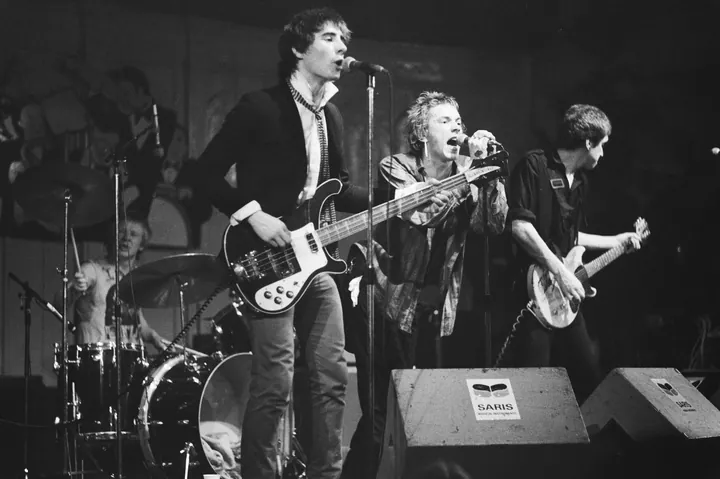 Photo: Koen Suyk / Anefo (Nationaal Archief) / CC0 1.0
· Winterland Ballroom
 Sex Pistols
 at the Winterland Ballroom, San Francisco, January 14, 1978
Last song performed “No Fun”
- Active years (1968 – November 25, 1976)
- Final show
- Islands, the last studio album by the original five, is released.1 year later
- The film The Last Waltz opens in the United States; it opens in Japan later the same year.2 years later
- The Band re-forms without Robbie Robertson.7 years later
- Richard Manuel dies, aged 42.10 years later
- Inducted into the Canadian Music Hall of Fame.13 years later
- Inducted into the Rock & Roll Hall of Fame.18 years later
- Jubilation, the third album by the 1990s lineup, is released.22 years later
- Rick Danko dies, aged 56.23 years later
- Receives a Grammy Lifetime Achievement Award.32 years later
- Levon Helm dies, aged 71.36 years later
- Rhino releases 40th-anniversary editions: two-CD, four-CD plus Blu-ray, and six-LP.40 years later
- The Last Waltz is screened at Zepp DiverCity in Tokyo, followed by Zepp Namba in Osaka on February 22.43 years later
- The Last Waltz is named to the Library of Congress's National Film Registry.43 years later
- Once Were Brothers: Robbie Robertson and the Band, a documentary based on Robertson's memoir, opens in Japan.44 years later
- Robbie Robertson dies, aged 80.47 years later
- Garth Hudson, the last surviving member, dies aged 87 (reported January 21).49 years later
Watch / buyPR
We may earn a commission if you buy through these links. Details

ラスト・ワルツ
Martin Scorsese's film (1978, about two hours), combining part of the concert with soundstage performances with Emmylou Harris and the Staple Singers and interviews; the night's "The Weight" and other songs are not included (Stereophile). Japanese Blu-ray (December 2023); catalog number from a Rakuten search, release date from a retailer's listing.
Related releases

ミュージック・フロム・ビッグ・ピンク +9(Music from Big Pink)
The 1968 debut album mentioned in the article.

ザ・バンド かつて僕らは兄弟だった
The documentary based on Robbie Robertson's memoir, mentioned in the article.
Supported by Rakuten Developers
Sources
28 sources
- The Band — Canadian Music Hall of Fame
- Garth Hudson, last surviving member of The Band, dies at 87 — The Associated Press, via PBS News, January 21, 2025
- The Band — Encyclopaedia Britannica
- Robbie Robertson Dead at 80 — Ultimate Classic Rock, August 9, 2023
- Robbie Robertson, leader of Canadian-US group The Band, dies at 80 — Reuters, via Al Jazeera, August 9, 2023
- The Band: Drifting Toward the Last Waltz — Rolling Stone, December 16, 1976
- ラスト・ワルツ — allcinema
- 10 things you should know about The Band's The Last Waltz — CBC Music
- Gala Farewell for the Live Band (Robert Hilburn) — Los Angeles Times; reprinted in the JoniMitchell.com Library of Articles, November 6, 1976
- Robbie Robertson On 'The Last Waltz,' 40 Years Later — NPR (Morning Edition), via KLCC, November 24, 2016
- Robbie Robertson on why The Band bid the road goodbye — CBC (from 90 Minutes Live, aired April 14, 1978)
- The Band: Farewell to Rock of Ages (Ben Kamhi) — Daily Nexus (University of California, Santa Barbara); reprinted in the JoniMitchell.com Library of Articles, December 2, 1976
- The Band's last waltz (Peter Goddard) — Toronto Star; reprinted in the JoniMitchell.com Library of Articles, November 27, 1976
- The Band: The Last Waltz 40th — Stereophile, January 17, 2017
- The Last Waltz: An Audience Member Revisits — Best Classic Bands
- ザ・バンド解散コンサートのライヴ・フィルム『ラスト・ワルツ』ライヴハウス上映(ソニー・ミュージックダイレクトのプレスリリース) — ソニー・ミュージックダイレクト(PR TIMES、日刊工業新聞の企業リリース欄), January 21, 2019
- ロビー・ロバートソンさん死去 80歳 「ザ・バンド」ギタリスト — AFPBB News, August 10, 2023
- Rick Danko Dies; Played Bass For Dylan, And The Band — The Associated Press, via The Seattle Times, December 11, 1999
- Levon Helm on The Band Reborn (Relix Revisited) — Relix, July 1, 2013
- The Band's Richard Manuel is Subject of 'His Life and Music' Book — Best Classic Bands, June 24, 2025
- Levon Helm, Legendary Drummer-Singer Of The Band, Dies — NPR, April 19, 2012
- The Band — Rock & Roll Hall of Fame
- Women Rule 2019 National Film Registry — Library of Congress, December 11, 2019
- Life Is A Carnival: The Band Celebrates 40 Years of "The Last Waltz" With New Reissues — The Second Disc, September 28, 2016
- ザ・バンド解散コンサートを収めたライヴ・フィルム『ラスト・ワルツ』のライブハウス上映ツアーが決定 — Billboard JAPAN, December 20, 2018
- ザ・バンド かつて僕らは兄弟だった — 映画.com
- MX-718SB の検索結果(ラスト・ワルツ Blu-ray) — 楽天市場
- It was 1978, the night they closed old Winterland — San Francisco Chronicle (SFGate)
Revision history
- Page created
 LCD Soundsystem