Final in retrospectHiroshima Heiankaku
Kyu Sakamoto's last concert: Hiroshima Heiankaku, August 10, 1985
On August 10, 1985, Kyu Sakamoto played two shows billed simply as the "Sakamoto Kyu Concert" at Hiroshima Heiankaku in western Japan. According to the set lists kept on his official website, he sang with the vocal group Wish, ran through his 1960 hit "Suteki na Taimingu," his new single "Natsukashiki Love-Song" and a children's song performed with sign language, and closed both shows by moving from "Miagete Goran Yoru no Hoshi o" into "Ue o Muite Arukō," the song the world knows as "Sukiyaki." In the official performance log, it is his last concert. Two days later, on August 12, Sakamoto taped an NHK-FM radio special before a studio audience in Tokyo, leading the room in a sing-along and performing "Kokoro no Hitomi," the B-side of his latest single. After the taping he boarded Japan Air Lines Flight 123 to Osaka, and died in its crash. He was 43. The program aired on September 1, and "Kokoro no Hitomi" went on to become a staple of Japanese school choirs.
Performance data
| Date | [5] |
|---|---|
| Venue | Hiroshima Heiankaku (Hiroshima Prefecture) |
| Event | Sakamoto Kyu Concert (坂本九コンサート) [5] |
| Category | Final in retrospect |
| Why it ended | Death [6][9][8] |
| Lineup | Kyu Sakamoto [5] |
| Attendance | UnverifiedNo source for the attendance was found. |
| Last song performed | “Sukiyaki” UnverifiedIn the official performance log, both shows end with "Ue o Muite Arukō." The official site notes that set lists are based on scripts and may differ from what was actually performed, so this is marked unverified.[5][2] |
| Songs performed | 8 songsSee the setlist ↓ |
| Video release | UnverifiedNo video or audio release of this show has been found (November 2026). |
About the artist
Kyu Sakamoto was born on December 10, 1941, in Kawasaki, just south of Tokyo. His real name was Hisashi Oshima, written with the character for "nine," and he was the youngest of nine children[1]. He started singing out of admiration for Elvis Presley and was spotted by the Manase Production agency while performing in a jazz café[2]. In 1958, still a high school student, he joined a rockabilly band called the Drifters, won a newcomer's prize at his first Nichigeki Western Carnival in August, and in November became a member of Danny Iida and Paradise King. He made his recording debut with Victor in June 1959, and his 1960 single "Kanashiki Rokujussai" for Toshiba became a hit, as did "Suteki na Taimingu" the same year[1].
The turning point came in 1961. "Ue o Muite Arukō," with music by Hachidai Nakamura and words by Rokusuke Ei, was introduced at a Nakamura recital on July 21 and caught on after Sakamoto sang it on the NHK television show "Yume de Aimashō," prompting a flood of requests for the sheet music. At the end of that year he made his first appearance on NHK's New Year's Eve "Kōhaku Uta Gassen," and he returned for the next ten years in a row[3][1].
On May 3, 1963, Capitol Records released the song in the United States as "Sukiyaki." A British instrumental version by Kenny Ball's band had reached No. 10 in the UK the year before, but in America it was a DJ in Fresno, California, playing Sakamoto's own recording that started the response[4]. The single entered the Billboard Hot 100 at No. 79 on May 11, reached No. 1 on June 15 and stayed there for three weeks; it also spent four weeks at the top of the Cash Box chart. In August he flew to the US to appear on ABC's "The Steve Allen Show." Sales passed one million, and on May 15, 1964, he became the first Japanese artist to receive a gold record[3].
More hits followed: "Miagete Goran Yoru no Hoshi o" and "Ashita ga Aru sa" in 1963 and "Shiawase Nara Te o Tatakō" in 1964[1]. He also took part in "Ayumi no Hako," a charity drive that grew out of visits to institutions for disabled children begun in 1963 by actors Junzaburo Ban and Hisaya Morishige; according to his official site, his performance of "Tomodachi" at the charity show drew a strong response[3]. He was a fixture as a host as well, presenting "Kōhaku" for the first time in 1968, serving as master of ceremonies of the World Popular Song Festival from 1970 to 1984, starting the Sapporo TV program "Fureai Hiroba Sunday Kyu" in 1976 and becoming the third host of Nippon TV's talent show "Star Tanjō!" in 1981. He married the actress Yukiko Kashiwagi on December 8, 1971[1].
Why this was the last show
The Hiroshima concert was never billed as a farewell. According to his official performance log, Sakamoto's 1985 began with a New Year dinner show at the Shin Takanawa Prince Hotel on January 2, followed by a music copyright society festival at the Ryōgoku Kokugikan in February, a show in Okinawa, a school thank-you party in March, two shows in Atsugi in April and a two-night engagement in Sapporo in June. Hiroshima on August 10 was simply the next date[5].
He was just as busy on television and radio. His official timeline lists recordings and broadcasts month after month for Sapporo TV's "Fureai Hiroba Sunday Kyu," TBS's "Kitchen Patrol" and TV Shin-Hiroshima's quiz show "Quiz Cross 5." On March 25 he appeared live on the final broadcast of Fuji TV's music show "Yoru no Hit Studio," and in late April he was filming on location in Brazil[6]. He was also the host of NHK General TV's "Kono Hito" profile series[7]. On May 22 he released a single on the Fun House label, "Natsukashiki Love-Song" backed with "Kokoro no Hitomi," and on June 8 the A-side was named one of the winning entries at the Koga Masao Memorial Music Awards, broadcast live on NHK television[6].
Two days after Hiroshima, on Monday, August 12, Sakamoto was in Studio 505 at NHK Broadcasting Center in Shibuya, Tokyo, for the public recording of an NHK-FM special, "Aki Ichiban! Sakamoto Kyu." According to the radio records on his official site, the guest was the singer Ouyang Fei Fei and the pianist was Kentaro Haneda. Sakamoto sang "Suteki na Taimingu," a duet of "Ue o Muite Arukō" with Ouyang and "For the Good Times," led the studio audience in "We Are the World," and went on to "Kokoro no Hitomi," "Oyaji," "Miagete Goran Yoru no Hoshi o" and "Natsukashiki Love-Song"[8]. Studio 505 was where he had sung on the live NHK Radio 1 program "Hatsuratsu Studio 505" in May[8].
After the recording he took a Japan Air Lines flight to Osaka[6]. He died in the crash of JAL Flight 123 on August 12, 1985, at the age of 43[9].
His official site describes the program as his last, recorded a few hours before the crash[8]. In the sense of singing in front of people, the August 12 taping was his final performance. This page is nonetheless set on August 10 because Shuenroku does not count recordings made for broadcast as live shows. The last time Sakamoto stood before an audience at a concert of his own, according to the official performance log, was at Hiroshima Heiankaku[5].
His "last TV appearance," a common search, cannot be pinned down from the official records. In the official list of TV programs, the last broadcast of "Kono Hito" was the episode on cinematographer Kazuo Miyagawa, aired on September 5 and recorded on June 13. Scripts survive for episodes planned for October, but the list does not say whether they aired[7]. August recordings or broadcasts of his regular shows could not be confirmed from the official timeline[6].
"Kokoro no Hitomi" is described as the last song he recorded in the studio. It was produced with Kazunaga Nitta, the music producer who founded Fun House[9][10].
What is known about the day
The "Sakamoto Kyu Concert" at Hiroshima Heiankaku was given twice on the same day, with backing vocals by Wish. The official performance log does not name the band, and no source was found for the start times, the size of the audience or the weather[5]. The official site also cautions that its set lists are based on show scripts and may differ from what was actually performed; the songs and running order below come from that record[2].
Hiroshima was a city Sakamoto visited often that year. He traveled there repeatedly to tape "Quiz Cross 5" in TV Shin-Hiroshima's studio, and on April 22 he served as honorary "one-day postmaster" of the Hiroshima post office[6]. "Nakinagara Warau Hi," a 1976 film he starred in, directed by Zenzo Matsuyama, had opened in Hiroshima ahead of the rest of the country[1].
The first show opened, like most of his other 1985 dates, with "Kono Yo no Aru Kagiri," followed by "Minna de Tsukurō" and his 1964 hit "Shiawase Nara Te o Tatakō"[5][1]. The second show also began with "Kono Yo no Aru Kagiri," but "Kogeyo Maikeru" took the place of those two songs, leaving the second set one song shorter, at eight[5].
The middle of both shows was the same: his 1960 hit "Suteki na Taimingu," Neil Diamond's "Sweet Caroline," and "Natsukashiki Love-Song," the new single released on May 22[5][6]. "Sweet Caroline" appears in almost every 1985 entry in the log, from the January dinner show to Sapporo in June. "Natsukashiki Love-Song" first appears in Sapporo, after its release[5].
Next came "Yūyake Koyake," a children's song about the evening sky, performed with sign language. In the log, the signed "Yūyake Koyake" enters the set at a school thank-you party at the Hotel New Otani on March 11 and stays through Atsugi in April, Sapporo in June and Hiroshima[5].
Both shows closed by moving from "Miagete Goran Yoru no Hoshi o," which shares its title with a 1963 musical Sakamoto appeared in, into "Ue o Muite Arukō." That pairing appears in every 1985 entry in the log that gives a full set list, from the January dinner show to Sapporo[5][1]. In January it was followed by "Nijūisseiki no Uta" and an encore; in Okinawa in February it was followed by "Ikite Ite Yokatta" and a poetry reading by Yukiko Kashiwagi, and in Atsugi in April "Nijūisseiki no Uta." In Hiroshima, as at the March school party and in Sapporo, nothing followed on the record: both shows ended with "Ue o Muite Arukō"[5].
"Kokoro no Hitomi," the B-side of his May single, was not in the Hiroshima set. In the official records, the only occasions on which he can be confirmed singing it in front of people are a public live broadcast from NHK's Yokohama station on June 22 and the NHK-FM taping on August 12[8].
No contemporary press report of the Hiroshima shows, and no account from anyone in the audience, was found.
What the show left behind
"Aki Ichiban! Sakamoto Kyu" aired on NHK-FM at 9 p.m. on September 1, 1985[8]. According to his daughter, the singer-songwriter Hanako Oshima, a schoolteacher who heard the broadcast arranged "Kokoro no Hitomi" for choir; it spread to schools around the country and eventually into music textbooks. As a B-side, she said, no one had expected it to be sung so widely[11]. The words are by Toyohisa Araki and the music by Takashi Miki, and in August 2023 a choir of 84 junior high school students sang it on the charity telethon "24-Hour Television"[12].
His family has kept singing it. Oshima said that in 2004 she recorded the song with her mother, Yukiko Kashiwagi, and her sister, and that they went on to sing it at Christmas concerts; in 2017, a version with the three women's voices added to Sakamoto's original recording was included on a best-of[11]. That album, "Sakamoto Kyu Best: Kokoro no Hitomi," was released by Universal Music in December 2017[13]. On July 12, 2019, BS TV Tokyo aired a three-hour special that presented "Kokoro no Hitomi" as his last recorded voice and singing, taped a few hours before his death[14].
Awards followed in the autumn of 1985: a special award at the 15th Ginza Music Festival and a music culture award at the Japan Lyricist Awards in October, and a special broadcast music award at the 16th Japan Kayō Awards in November. "Ue o Muite Arukō," which had received the overseas category award from JASRAC, Japan's music copyright society, in 1983, received it again in 1986 and 1987[1].
The song itself kept traveling. According to Billboard JAPAN, A Taste of Honey's 1981 cover spent 24 weeks on the Hot 100, and 4 P.M.'s version charted for 32 weeks in 1994 and 1995. In Japan, RC Succession played it on stage from the late 1970s and recorded it on their 1981 album "EPLP"[4]. On November 21, 2024, the song was honored by the Japan Composers Association at the 66th Japan Record Awards[1].
An asteroid discovered in 1993, No. 6980, was named Kyusakamoto[3]. In Kawasaki, his hometown, memorial concerts are held on the anniversary of his death. In 2023 the Kanagawa Shimbun reported that pupils from Kawasaki Elementary School, his alma mater, would perform at an event space at the Kawasaki Le Furon shopping center by JR Kawasaki Station on August 12[15].
For the 40th anniversary in 2025, Universal Music released a three-CD, 61-track set titled simply "Sakamoto Kyu" on August 20[16]. Nippon Broadcasting System aired a late-night special, with Yukiko Kashiwagi and Kazunaga Nitta, who produced "Kokoro no Hitomi" with Sakamoto, as guests[9].
In 2026 came a feature film about the making of "Ue o Muite Arukō," "Sukiyaki: Ue o Muite Arukō," directed by Takahisa Zeze and distributed by Toho. Taiga Nakano plays Sakamoto, Junichi Okada plays Hachidai Nakamura and Tori Matsuzaka plays Rokusuke Ei. It was chosen as the opening film of the 39th Tokyo International Film Festival, which began on October 26, and its theatrical release is scheduled for December 25. In May, "Kokoro no Hitomi" was used in a new television commercial for Suntory Tennensui mineral water[10].
On the record, both Hiroshima shows ended with "Ue o Muite Arukō." "Kokoro no Hitomi," left out of those sets, was sung at a radio taping two days later and is now sung in school choirs.
Context for readers
Kayōkyoku and "Sukiyaki." Kayōkyoku is the Japanese term for the mainstream popular song of the postwar Shōwa era, the world of TV variety shows, New Year's Eve "Kōhaku" appearances and hotel dinner shows in which Sakamoto worked. "Ue o Muite Arukō" was written in Japanese by a Japanese team; "Sukiyaki," the name of a beef hot-pot dish, was the title it was given for its release abroad, and it is the name under which the song topped the American chart in 1963.
Two last dates. Shuenroku pages are set on an artist's last live show before an audience. Radio and TV tapings are covered in the text but not counted, even when, as on August 12, 1985, a studio audience was present. That is why this page is the August 10 concert in Hiroshima, not the NHK-FM recording in Tokyo.
Related releasesPR
We may earn a commission if you buy through these links. Details

坂本九 ベスト~心の瞳
The 2017 best-of mentioned in the article, which includes "Kokoro no Hitomi" with his family's chorus added to the original recording (according to Hanako Oshima). Not a recording of this show.

心の瞳
A 2017 CD of "Kokoro no Hitomi," described as the last song he recorded and discussed in the article. Track details not checked. Not a recording of this show.

Supported by Rakuten Developers
Setlist
8 songs Unverified[5][2]Main set Cover Last song
- この世のある限り “Kono Yo no Aru Kagiri” (As long as this world exists)
- 漕げよマイケル “Kogeyo Maikeru” (Row, Michael)
- ステキなタイミング “Suteki na Taimingu” (Wonderful timing)
- Sweet Caroline
- 懐しきLove-song “Natsukashiki Love-Song” (A love song from the past)
- 夕やけこやけ “Yūyake Koyake” (Sunset glow)
- 見上げてごらん夜の星を “Miagete Goran Yoru no Hoshi o” (Look up at the stars in the night sky)
- Sukiyaki
Another final curtain
More nights that no one knew would be the last.
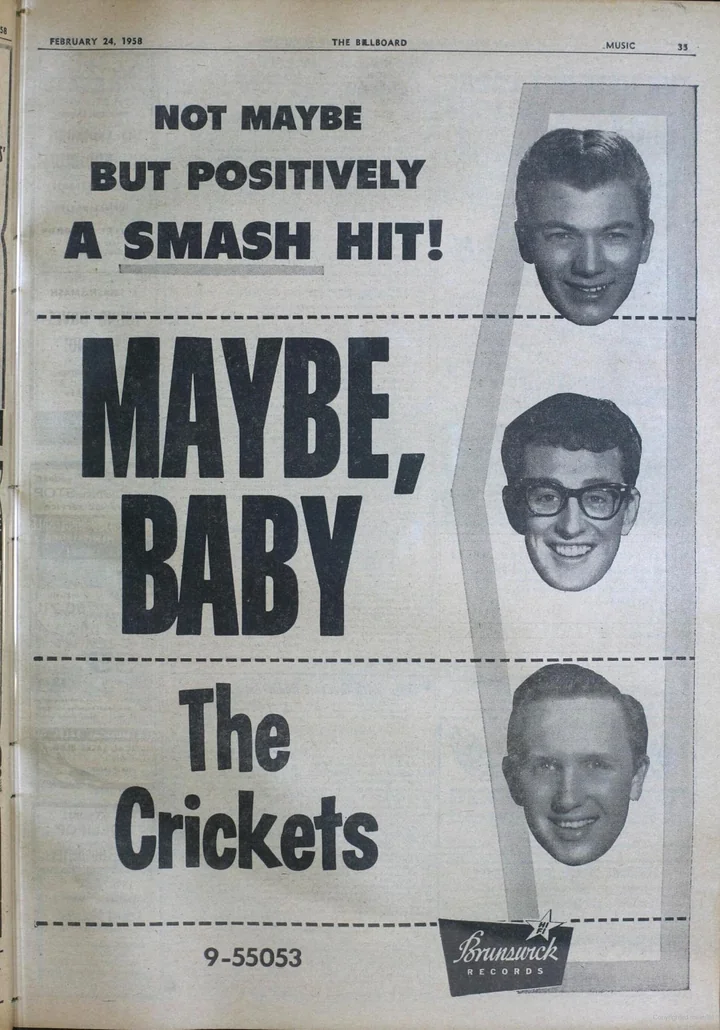 Photo: Brunswick Records (advertisement; photographer unknown) / Public Domain (US, published before 1978 without notice)
· Surf Ballroom
 Buddy HollyNEW
Buddy Holly's last concert: Surf Ballroom, Clear Lake, Iowa, February 2, 1959
· NHK Hall
 Teresa TengNEW
Teresa Teng's last concert in Japan: NHK Hall, Tokyo, December 15, 1985
Last song performed 愛人 “Aijin”
- Active years (1958 – August 10, 1985)
- Final show
- Public recording of the NHK-FM program "Aki Ichiban! Sakamoto Kyu" in Studio 505 at NHK Broadcasting Center, Shibuya, Tokyo, with guest singer Ouyang Fei Fei and pianist Kentaro Haneda. He sings songs including "Kokoro no Hitomi" and leads the studio audience in "We Are the World."
- Dies in the crash of Japan Air Lines Flight 123, bound for Osaka after the recording, aged 43.
- "Aki Ichiban! Sakamoto Kyu" airs on NHK-FM (9:00–9:55 p.m.).
- NHK General TV airs "Kono Hito: Miyagawa Kazuo Show" (recorded June 13), which he hosted; the last broadcast of the "Kono Hito" series in the official site's TV records.
- Receives a special broadcast music award at the 16th Japan Kayō Awards (in October, a special award at the 15th Ginza Music Festival and a music culture award at the Japan Lyricist Awards).
- His daughter Hanako Oshima records "Kokoro no Hitomi" with her mother, Yukiko Kashiwagi, and her sister.19 years later
- Best-of "Sakamoto Kyu Best: Kokoro no Hitomi" (UPCY-7456) is released, including "Kokoro no Hitomi" with the family's chorus added to his original recording.32 years later
- "Ue o Muite Arukō" is honored by the Japan Composer's Association at the 66th Japan Record Awards.39 years later
- 40th anniversary of his death. Three-CD set "Sakamoto Kyu" (UPCY-8065/7, 61 tracks) is released.40 years later
- "Sukiyaki: Ue o Muite Arukō," a film about the making of the song (directed by Takahisa Zeze, with Taiga Nakano as Sakamoto), opens the 39th Tokyo International Film Festival. Theatrical release is scheduled for December 25, 2026.41 years later
Sources
20 sources
- Profile | Sakamoto Kyu Official Website — 坂本九公式ホームページ(マナセプロダクション)
- 坂本九公式ホームページ Sakamoto Kyu Official Website — マナセプロダクション
- Episode | Sakamoto Kyu Official Website — 坂本九公式ホームページ(マナセプロダクション)
- 今から50年前、全米を制したのは日本の音楽だった。 — Billboard JAPAN
- LIVE 1980〜85 | Sakamoto Kyu Official Website — 坂本九公式ホームページ(マナセプロダクション)
- Memory 1985 | Sakamoto Kyu Official Website — 坂本九公式ホームページ(マナセプロダクション)
- TV 1980〜1985 | Sakamoto Kyu Official Website — 坂本九公式ホームページ(マナセプロダクション)
- RADIO | Sakamoto Kyu Official Website — 坂本九公式ホームページ(マナセプロダクション)
- 坂本九、没後40年の夏に送るスペシャル・プログラム「坂本九 メモリアルコレクション ~見上げてごらん夜の星を~」ニッポン放送にて8月10日26時40分よりオンエア決定 — TOWER RECORDS ONLINE(タワーレコード), August 6, 2025
- Topics 2026 | Sakamoto Kyu Official Website — 坂本九公式ホームページ(マナセプロダクション)
- シンガー・ソングライター大島花子さん「亡き父 坂本九の最後の曲『心の瞳』を広めたい」 — 日刊ゲンダイDIGITAL, August 4, 2025
- 坂本九「心の瞳」歌詞の意味は?合唱曲としても知られる究極のラブソングを考察! — UtaTen(森康弘), September 19, 2023
- ベスト-心の瞳(坂本九、UPCY-7456) — 国立国会図書館サーチ
- 貴重な最後の肉声と歌声“心の瞳”を公開!『武田鉄矢の昭和は輝いていた 永遠の笑顔 坂本九 3時間SP』 — テレビ東京, July 9, 2019
- 坂本九さんをしのび 命日の12日 川崎で追悼コンサート — 神奈川新聞(カナロコ), August 8, 2023
- 坂本九/坂本九(UPCY-8065/7) — 紀伊國屋書店ウェブストア
- 『水曜歌謡祭』名曲「上を向いて歩こう」レア・カヴァーから00年代の歌姫ナンバーまで昭和~平成の音楽シーンを網羅した充実の2時間SP — Billboard JAPAN, June 18, 2015
- 楽天市場「UPCY-7456」の検索結果 — 楽天市場
- 楽天市場「UPCY-5055」の検索結果 — 楽天市場
- 楽天市場「UPCY-8065」の検索結果 — 楽天市場
Revision history
- Page created
 Hibari Misora
 Bob Marley