Final in retrospectKitakyushu Soleil Hall
Hibari Misora's last stage: Kyushu Kosei Nenkin Kaikan, Kokura, February 7, 1989
On February 7, 1989, Hibari Misora gave two shows, one in the afternoon and one in the evening, at the Kyushu Kosei Nenkin Kaikan, a concert hall in Kokura, Kitakyushu. It was only the second day of a nationwide tour, and it turned out to be her last concert. Her final single, "Kawa no Nagare no Yō ni" ("like the flow of a river"), released less than a month earlier, was among the songs she sang that day, and the concert survives on a live album.
Performance data
| Date | [3][6] |
|---|---|
| Venue | Kitakyushu Soleil Hall (Kitakyushu, Fukuoka)Known as 九州厚生年金会館 at the time |
| Event | UnverifiedOne date of her 1989 nationwide tour. Her official website calls it simply the '89 nationwide tour, and no title for the show or the tour has been found. The official live album is titled Uta wa Waga Inochi 1989 in Kokura ~Misora Hibari Last on Stage "Sayonara no Mukō ni"~ (Nippon Columbia). For reference only: Wikipedia gives the tour's name as "Uta wa Waga Inochi" ("singing is my life").[3][6][16] |
| All dates | February 6, 1989, February 7, 1989 [3] |
| Category | Final in retrospect |
| Why it ended | Death [3][1][6] |
| Lineup | Hibari Misora [3][6] |
| Attendance | UnverifiedNo official or press figure for the attendance was found. |
| Last song performed | UnverifiedFor reference: the final track of the official live album (2005, reissued in 2024) is "Sayonara no Mukō ni" ("beyond goodbye"), and the 2024 edition's subtitle carries the song's name. Official sources do not say whether the album was recorded at the afternoon or the evening show, or confirm this as the last song she sang that day.[6] |
| Songs performed | 20 songs (Partially known)See the setlist ↓ |
| Video release | UnverifiedNo official video of this concert has been found. The audio was released on CD in 2005 as Uta wa Waga Inochi 1989 in Kokura and reissued with a subtitle in 2024 (Nippon Columbia). |
About the artist
Hibari Misora was born in Isogo, Yokohama, on May 29, 1937[1]. According to Nippon Columbia, her record label, she first appeared on stage in December 1945 at the Sugita Theater in her home district, and she made her record debut in 1949 with "Kappa Boogie-Woogie"[1]. The same year she starred in the film Kanashiki Kuchibue ("sad whistle"). Its theme song of the same name became a hit, and she signed an exclusive contract with Columbia. One Japanese reference work counts 157 films in which she appeared[2].
Her best-known songs include "Ringo Oiwake" ("apple oiwake," a folk-song style), "Yawara" ("gentleness," the first character of the word judo) and "Kanashii Sake" ("sad sake"). She first took part in Kōhaku Uta Gassen, NHK's New Year's Eve song contest, in 1954[2]. At the Japan Record Awards, an annual music prize, she won the singing award for "Aishū Hatoba" ("wharf of sorrow") in 1960 and the grand prize for "Yawara" in 1965. Columbia says she recorded more than 1,500 songs[1].
Why this was the last show
On April 11, 1988, Misora staged a concert at Tokyo Dome titled Fushichō ("phoenix")[1]. According to her official website, she sang 39 songs there to an audience of 50,000, and from May 25 that year she played 13 venues around Japan, starting at Fukuoka Sunpalace Hall[3].
On January 11, 1989, she released "Kawa no Nagare no Yō ni," with lyrics by Yasushi Akimoto and music by Akira Mitake. Nippon Columbia describes it as her last single[4]. Her son, Kazuya Kato, has said that a different song had originally been planned as the single and was replaced at her own wish, and that bringing in Akimoto reflected her hope of reaching younger listeners[5].
According to her official website, her 1989 nationwide tour opened on February 6 with an afternoon and an evening show at Fukuoka Sunpalace Hall. The next day she gave two more shows, again in the afternoon and the evening, at the Kyushu Kosei Nenkin Kaikan in Kokura[3].
She never appeared on a stage again. On March 21 she took part from her home in a ten-hour radio program on Nippon Broadcasting System, Misora Hibari, Kandō no Kono Ikkyoku ("this one song that moved me"), and on March 23 the cancellation of her show planned for April 17 at Yokohama Arena was announced[3]. Misora died on June 24, 1989, at the age of 52[3][1]. The Kokura concert had not been billed as a farewell. Nippon Columbia describes it as the last performance she gave her fans from the stage[6].
What is known about the day
The Kyushu Kosei Nenkin Kaikan stands in Ōtemachi, in the Kokura Kita ward of Kitakyushu. It was completed in April 1984[7], and its main hall has 2,008 seats today[8]. Misora's official website lists an afternoon and an evening show there on February 7[3].
The concert was recorded. Nippon Columbia released it on CD in 2005 as Uta wa Waga Inochi 1989 in Kokura ("singing is my life"), and reissued it on May 29, 2024, her birthday, with the subtitle Misora Hibari Last on Stage "Sayonara no Mukō ni"[6].
The two discs hold 20 tracks. The first opens with an "Ōpuningu Medorē" (opening medley) and includes "Makka na Taiyō" ("bright red sun"), "Minatomachi Jūsan-banchi" ("No. 13, Harbor Town") and "Midaregami" ("tangled hair"). The second runs from "Kanashii Sake" ("sad sake") through "Kawa no Nagare no Yō ni," "Ai Sansan" ("love, shining bright") and "Jinsei Ichiro" ("life on a single road") to "Sayonara no Mukō ni" ("beyond goodbye")[6]. "Kawa no Nagare no Yō ni" had been out for less than a month. According to the track listing, several tracks also include her spoken introductions between songs[9].
The product information does not say whether the album comes from the afternoon or the evening show, or whether it holds the whole concert in its original order[6]. We have not found an official setlist for the day, or an official source that names the last song she sang. Whether the album's closing track, "Sayonara no Mukō ni," whose title also appears in the subtitle, was the final song of the day remains unconfirmed.
What the show left behind
In July 1989, after her death, Misora was given the People's Honour Award, the first woman to receive it[1][3]. The encyclopedia Nipponica says the award recognized how she had given people dreams and hope through popular song[10]. That year, "Kawa no Nagare no Yō ni" won a Gold Award at the 31st Japan Record Awards[2].
The Kokura recording came out 16 years after the concert, in 2005[6]. In 2019, 30 years after her death, "Kawa no Nagare no Yō ni" was reissued on her birthday, May 29, on 12cm CD, 8cm CD, cassette and 7-inch vinyl[4], and her son Kazuya Kato, president of her management company, Hibari Production, announced that her lifetime sales had passed 100 million[11]. On September 29 that year, NHK aired AI de Yomigaeru Misora Hibari ("Hibari Misora revived by AI"), a documentary about an attempt to re-create her singing voice with AI. "Arekara" ("since then"), the new song produced by Akimoto for that project, was released on December 18[12][13].
The city of Kitakyushu bought the hall in 2010, and it has since been run as Kitakyushu Soleil Hall[7][14]. According to the city, the building had aged considerably after about 40 years, and it has been closed since April 1, 2025, for a survey ahead of renovation[15][8].
The songs she sang in Kokura on February 7, 1989, live on in a recording on two CDs.
Context for readers
Hibari Misora. Her stage name combines misora ("beautiful sky") and hibari ("skylark").
The People's Honour Award. Created in 1977, it is presented by the Prime Minister of Japan to people who are widely loved and have given the public hope through outstanding achievements. The first recipient, in 1977, was the baseball player Sadaharu Oh[10].
Kokura and the hall. The hall is in the Kokura Kita ward of Kitakyushu, a city in Fukuoka Prefecture in northern Kyushu[8]. Kōsei nenkin is Japan's employees' pension insurance, so the hall's original name means roughly "Kyushu Employees' Pension Hall." The city now refers to the building as the former Kyushu Kosei Nenkin Kaikan, and to the hall as Kitakyushu Soleil Hall[8].
NHK and Nippon Broadcasting System. NHK is Japan's public broadcaster. Nippon Broadcasting System is a commercial radio station in Tokyo.
Names and titles. Japanese names in this article are given in Western order (given name first); in Japan she is known as Misora Hibari. Japanese song and album titles are romanized, with a rough meaning in parentheses; these are not official English titles.
Setlist
20 songs · Partially known Unverified[6][9]Main set Last song
- オープニングメドレー “Ōpuningu Medorē” (Opening medley)
- 真赤な太陽 “Makka na Taiyō” (Bright red sun)
- ひとり旅〜「リンゴ追分」入り〜 “Hitoritabi (Ringo Oiwake iri)” (Traveling alone, with Ringo Oiwake worked in)
- 車屋さん “Kurumaya-san” (The rickshaw man)
- 港町十三番地 “Minatomachi Jūsan-banchi” (No. 13, Harbor Town)
- 髪 “Kami” (Hair)
- 夾竹桃の咲く頃 “Kyōchikutō no Saku Koro” (When the oleanders bloom)
- 芸道一代 “Geidō Ichidai” (A lifetime on the stage)
- われとわが身を眠らす子守唄 “Ware to Waga Mi o Nemurasu Komoriuta” (A lullaby to sing oneself to sleep)
- NANGIやね “NANGI ya ne” (It's tough, isn't it)
- みだれ髪 “Midaregami” (Tangled hair)
- 悲しい酒(セリフ入り) “Kanashii Sake (serifu iri)” (Sad sake, with spoken lines)
- もやい酒 “Moyai-zake” (Sake shared together)
- 背中 “Senaka” (Someone's back)
- ハハハ “Ha Ha Ha” (Laughter)
- 川の流れのように “Kawa no Nagare no Yō ni” (Like the flow of a river)
- 愛燦燦 “Ai Sansan” (Love, shining bright)
- むらさきの涙 “Murasaki no Namida” (Purple tears)
- 人生一路 “Jinsei Ichiro” (Life on a single road)
- さよならの向うに “Sayonara no Mukō ni” (Beyond goodbye)
Another final curtain
More nights that no one knew would be the last.
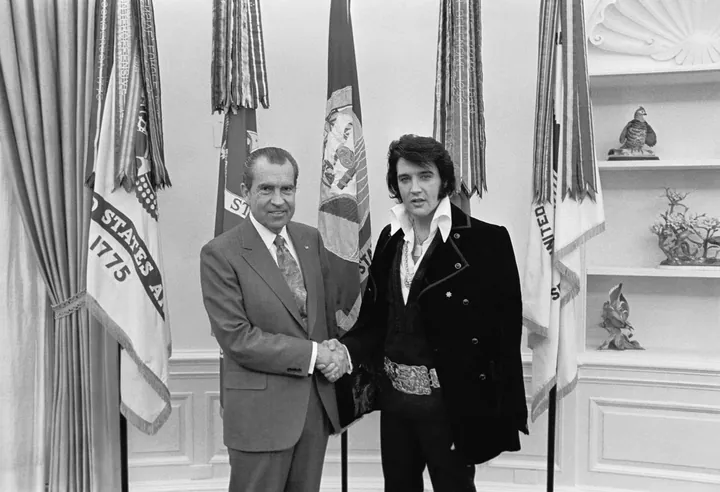 Photo: Ollie Atkins (White House) / Public Domain (US Government)
· Market Square Arena
 Elvis PresleyNEW
Elvis Presley's last concert: Market Square Arena, Indianapolis, June 26, 1977
Last song performed “Can't Help Falling in Love”
· Yoyogi National Gymnasium
 Yutaka Ozaki
Yutaka Ozaki's last concert at Yoyogi National Gymnasium, October 30, 1991
Last song performed ダンスホール “Dansu Hōru”
- Active years (1949 – February 7, 1989)
- Final show
- Appears from her home on Nippon Broadcasting System's ten-hour radio program Misora Hibari, Kandō no Kono Ikkyoku.
- The cancellation of her concert planned for April 17 at Yokohama Arena is announced.
- Hibari Misora dies at the age of 52.
- She is posthumously awarded the People's Honour Award, the first woman to receive it.
- The concert is released on CD as Uta wa Waga Inochi 1989 in Kokura (two discs).16 years later
- The city of Kitakyushu acquires the Kyushu Kosei Nenkin Kaikan, which is later run as Kitakyushu Soleil Hall.21 years later
- Her son, Kazuya Kato, announces that her lifetime sales have passed 100 million.30 years later
- "Kawa no Nagare no Yō ni" is reissued on 12cm CD, 8cm CD, cassette and 7-inch vinyl.30 years later
- NHK broadcasts the documentary AI de Yomigaeru Misora Hibari, about re-creating her singing voice with AI.30 years later
- "Arekara," a new song sung by an AI re-creation of her voice, is released.30 years later
- The concert CD is reissued with the subtitle Misora Hibari Last on Stage "Sayonara no Mukō ni."35 years later
- The former venue, now Kitakyushu Soleil Hall, closes for a survey of its aging building.36 years later
Watch / buyPR
We may earn a commission if you buy through these links. Details

歌は我が命 1989 in 小倉 〜美空ひばりラスト・オン・ステージ「さよならの向うに」〜
Two CDs, 20 tracks (45:15 and 39:34). Nippon Columbia says it contains the February 7, 1989, concert at the Kyushu Kosei Nenkin Kaikan, but the product information does not say whether it was recorded at the afternoon or the evening show, or whether it is the complete show. Same content as the 2005 release Uta wa Waga Inochi 1989 in Kokura (COCP-33249/50).
Supported by Rakuten Developers
Sources
- 美空ひばり プロフィール — 日本コロムビア
- 美空ひばり — コトバンク(日本大百科全書(ニッポニカ)、ブリタニカ国際大百科事典 小項目事典、デジタル版 日本人名大辞典+Plus、20世紀日本人名事典ほか)
- プロフィール — 美空ひばり 公式ウェブサイト
- 川の流れのように【12cmCD】 — 日本コロムビア
- 美空ひばり息子が語る…発売30年「川の流れのように」誕生秘話 — 琉球新報デジタル, January 11, 2019
- 歌は我が命 1989 in 小倉 〜美空ひばりラスト・オン・ステージ「さよならの向うに」〜 — 日本コロムビア
- 旧九州厚生年金会館大規模改修事業等に関するサウンディング調査 実施要領 — 北九州市 市民文化スポーツ局, December 22, 2021
- 芸術文化施設 — 北九州市, September 11, 2026
- 歌は我が命 1989 in 小倉〜美空ひばりラスト・オン・ステージ「さよならの向うに」〜 — 楽天ブックス
- 国民栄誉賞 — コトバンク(日本大百科全書(ニッポニカ)、デジタル大辞泉ほか)
- 美空ひばりさん、生涯売上枚数が1億枚を突破 ファンからも惜しみない拍手 — ORICON NEWS
- AIでよみがえった美空ひばりが新曲披露コンサート、その舞台裏をNHKでオンエア — ぴあ(音楽ナタリー), September 27, 2019
- 美空ひばり(AI歌唱)「あれから」2019年12月18日発売! — 日本コロムビア
- 旧九州厚生年金会館の管理運営事業者の更新について — 北九州市 市民文化スポーツ局, January 16, 2020
- 北九州ソレイユホール及びザ・スティール・ハウス(旧九州厚生年金会館)の休館について — 北九州市 都市ブランド創造局, September 6, 2024
- 美空ひばり — Wikipedia(日本語)
Revision history
- Page created
 Bob Marley