Planned as the final showNaeba Ski Resort
BLANKEY JET CITY at FUJI ROCK FESTIVAL '00, Naeba Ski Resort, July 28, 2000
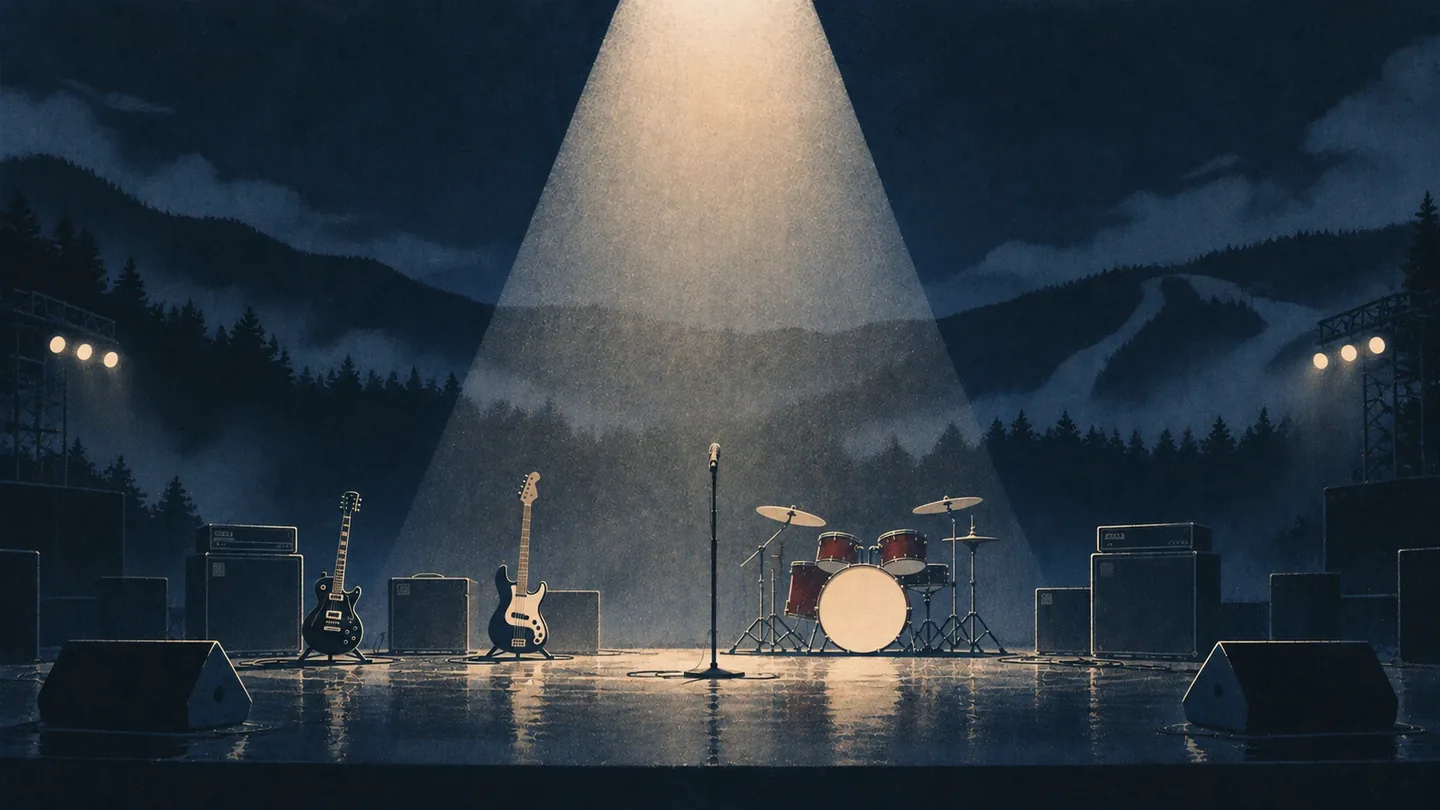
BLANKEY JET CITY announced their breakup in May 2000 and played their last concerts of their own, LAST DANCE, at Yokohama Arena on July 8 and 9. Their final stage came on July 28, when they closed the first day of FUJI ROCK FESTIVAL '00 at Naeba Ski Resort. The trio played for about 90 minutes without a break, starting with "Puranetariumu," and the rain that had been falling stopped early in the set. At the end of the main set Toshiyuki Terui kicked over his mic stand and Tatsuya Nakamura threw his sticks at the drum kit and walked off. Back for the encore, Kenichi Asai gently announced the last song and added that he thought music mattered a great deal all over the world. The last song was "BABY BABY."
Performance data
| Date | [1][12][9] |
|---|---|
| Venue | Naeba Ski Resort (Yuzawa, Niigata) |
| Event | FUJI ROCK FESTIVAL '00 [13][18][12][9][8] |
| Category | Planned as the final show |
| Why it ended | Breakup [1][5] |
| Lineup | Kenichi Asai, Toshiyuki Terui, Tatsuya Nakamura [9] |
| Attendance | UnverifiedNo source gives a crowd figure for the BLANKEY JET CITY set. For reference, the festival's official record gives an attendance of 61,000 for the three days of 2000.[12] |
| Last song performed | “BABY BABY” [9] |
| Songs performed | 22 songsSee the setlist ↓ |
| Video release | Yes [14][15][18] |
About the artist
BLANKEY JET CITY were a rock trio: Kenichi Asai on vocals and guitar, Toshiyuki Terui on bass and Tatsuya Nakamura on drums[1]. All three came from Nagoya[2], and the band's formation is dated either to 1987 in Nagoya[3] or to February 1990 in Tokyo[2]. In August 1990 they appeared on the TBS television show Miyake Yuji no Ikasu Band Tengoku[4], won five weeks running to become its sixth "Grand Ika-ten King," and promptly signed with Toshiba EMI[2].
Their major-label debut, the album Red Guitar and the Truth, came out on April 12, 1991[1]. "Akai Tanbarin" ("red tambourine") and "Danderaion" ("dandelion") were hits in 1998[5], and the band's official site also names "Fuyu no Sētā" ("winter sweater"), "Warui Hitotachi" ("bad people") and "Gasorin no Yurekata" ("the way gasoline sways") among their best-known songs[1]. The writer Dai Onojima recalls that at their early shows the audience often stayed completely silent when a song ended: not out of boredom, he says, but because no one knew how to react to what they had just heard[5].
Why this was the last show
In November 1999, BLANKEY JET CITY went to Britain to record their next album, and in December they played 15 dates around Japan on the CONTINENTAL PUNK tour. Their 15th single, "Sea Side Jet City," followed on April 12, 2000[6].
On May 10, 2000, the day their final album, HARLEM JETS, came out, the band announced in a newspaper advertisement that they were breaking up[1][5]. According to their former manager, Tsutomu Fujii, the three had always worked at such a pitch, live and in the studio, that talk of splitting came up again and again. They could have simply stopped without a word. Instead they decided to declare a "breakup" outright, to draw a line under all that, and to tour one last time for the people who had helped them along the way[7]. The writer Dai Onojima, who had covered the band since before their debut, says the news did not surprise him: there had always been a tension in the band that could have ended it at any moment[5].
The farewell tour, LOVE IS DIE DIE IS A CHANGE, ran for 15 dates from Zepp Sapporo on May 21 to June 17. A last single, "SATURDAY NIGHT," came out on July 5, and the tour ended with LAST DANCE, two nights at Yokohama Arena on July 8 and 9[6]. The official site calls them the band's last "one-man" concerts[1]. Fujii recalls arriving in Sapporo for the first night and realizing, only then, that the tour led nowhere: there would be no growing or improving, only a journey to break the band apart. He says he remembers little of that day beyond Asai telling him to pull himself together. Throughout the tour, he adds, the three never once used separate dressing rooms; they sat in the same room and barely spoke[7].
Yokohama was not the last stage, though. In Fujii's account, the formal ending was the tour and Yokohama; Fuji Rock, which came afterwards, was more of a present to the three. He suggested finishing at the festival, which he saw as a new culture born in Japan, so that fans who knew only Blankey might discover other music there. The members said it sounded like them, and it was settled. Since the band had already granted his team's requests for songs they rarely played, especially at Yokohama, he says, ending at Fuji Rock meant they could simply tear straight through. Because the band was about to disappear, he also wanted to leave something behind for the next generation, and the festival finale came from that idea[7]. Onojima reads it the same way: a festival open to anyone was a place to hand the band's legacy on to younger listeners[5].
According to the official site, the festival set on July 28 became the band's final stage[1]. It came after the farewell tour had ended[8], and BARKS, reporting from Naeba, introduced it as the last stage of a band that had announced its breakup[9].
Sources still differ on where the band ended. Kenichi Asai's official profile dates the breakup to July 9 at Yokohama Arena[10], while a 2025 Natalie feature says the band broke up with its Fuji Rock appearance[4]. One fan quoted on Fuji Rock's official fan site in 2024 remembered feeling that Yokohama was the real ending and Fuji Rock a lucky bonus[11]. This page covers the band's last stage rather than their last one-man show.
What is known about the day
The 2000 festival ran for three days from July 28 at Naeba Ski Resort in Niigata Prefecture, its second year there. More than 100 acts played on four stages, and the festival's official attendance figure is 61,000[12]. On the first day, the GREEN STAGE bill included Foo Fighters and The Chemical Brothers, with BLANKEY JET CITY listed last; THEE MICHELLE GUN ELEPHANT closed the same list the next day[12]. They were the festival's first Japanese headliners[13].
BARKS reported a cheer as the three took their places on the dim stage. They opened, a little unexpectedly, with "Puranetariumu" ("planetarium"). It was not a showy start, the reporter wrote; the three seemed to feel each other out and let the energy build slowly. He wondered whether Asai had wanted to play that song under the stars at Naeba, and noted that before long the rain, which had been falling steadily, stopped[9]. Writing for Natalie in 2025, Tomonori Shiba describes a roar the moment the three appeared, and a band that played on without any show of sentiment[13].
By the third song, "SKUNK," the crowd was fired up; the reporter wrote that ground that should not move was shaking. Three singles in a row, "Akai Tanbarin," "Gasorin no Yurekata" and "SATURDAY NIGHT," drew a mass singalong, though the band did nothing to push it. During early songs rarely heard by then, "Zetsubō to Iu Na no Chikatetsu" ("a subway called despair") and "SOON CRAZY," Tatsuya Nakamura was so carried away that he came out from behind the kit and hit gear that had nothing to do with the drums. Asai fired off lines at speed in "3104-chōme no DANCE HALL ni Ashi o Mukero," and Toshiyuki Terui switched to upright bass for the rockabilly lines of "Romeo." The reporter admitted that the band seemed nervous early on, with a few slips, before working up to something close to full power[9].
After "Boku wa Yankī" came an unfamiliar up-tempo number that the BARKS reporter took for a new song; fan sites were already guessing it was a reworking of a song from the first album by Asai's other band, SHERBETS. The main set ended with "D.I.J. no Pisutoru" ("D.I.J.'s pistol"), during which Terui let out a yell and kicked his mic stand over. The last four songs came at high speed without a pause. The reporter, who had followed the band since their debut, wrote that he had never seen them finish so hard. Nakamura threw his sticks at the kit and walked off, and Terui put his bass down with unusual roughness, so roughly that the reporter wondered whether there would be an encore at all[9].
The cheering brought them back. Gently, as if talking to a friend, Asai announced the last song; BARKS notes that this was the first time that day a member had spoken of the end. Then, as if something had just occurred to him, he added that he thought music was something very important all over the world[9][13]. The song was "BABY BABY." The reporter ended his piece by saying he could no longer see for tears[9]. The band's official timeline describes a 90-minute set played straight through, perhaps the first in their history, closing a career of ten years and five months[6].
In a report from Fuji Rock Express '00, reprinted on the festival's official fan site in 2024, the writer contrasted the two endings: at Yokohama the three had held the band together at the edge of their nerves, while at Naeba each ran wild in his own direction and the band only just held its shape. That, he felt, was what let fans accept that it was over. On the afternoon of the third day he asked nine longtime fans how they had seen it. They had watched from in front of the mixing desk, in the mosh pit, outside the barrier of the front block and up on the hill, and most said they had danced. One said Nakamura's runaway drumming stood out; another singled out Terui's kicks[11].
Shiba was at both Yokohama and Naeba. There were no flashy effects or video, he recalls, only guitar, bass, drums and a voice, and a stage on which the three seemed to burn up everything they had[1].
What the show left behind
On July 28, 2025, exactly 25 years later, the band's official YouTube channel posted "Gasorin no Yurekata" from that night, upconverted to 4K[14][15]. A year earlier, the label had put the band's whole catalog on streaming services on July 28, explaining that the date marked the Fuji Rock headline set and the band's last stage[16]. LAST DANCE, the last one-man shows, came out as an album and on video on September 20, 2000[6], and a 2025 box set collected both nights in full[17]; it reached No. 4 on Oricon's weekly Blu-ray chart[18].
After the split, Fujii and his team deliberately held back. Plenty had already been released around the breakup, he says, and squeezing more out of fans felt like the music industry's "breakup business," which did not suit the band, so they stopped further releases. One of the two best-of albums that came out on October 25, 2000, BLANKEY JET CITY 1997-2000[6], included "Kuroi Uchū" ("black universe"), an unreleased song from the LOVE FLASH FEVER period, and the filmmaker Yutaka Onaga, who had followed the farewell tour with a camera, made a video for it using tour footage. Less than a year after the split Onaga proposed turning his footage into a film; Fujii said the time was not right[7].
Onaga's film of the last tour, VANISHING POINT, was finally shown in cinemas for one day on January 26, 2013[19]. According to Fujii, Terui agreed to it only if Fujii was ready to give it everything, and told him on parting that if it turned out well and the fans were happy, that was enough for him. Nakamura was the only member at the preview screening; Asai watched the director's cut on DVD, and Terui said he would not watch it for now, because he was living looking forward[7].
After the breakup, Asai stepped up his work with SHERBETS and went on to AJICO, with the singer UA, and JUDE, started in 2002. Nakamura turned his project LOSALIOS into a full band, and Terui began a project called CARNE in 2001 and also formed ROSSO with Yusuke Chiba of THEE MICHELLE GUN ELEPHANT[20]. Writing in 2024, Dai Onojima noted that BLANKEY JET CITY had not played in public since 2000, and that they and THEE MICHELLE GUN ELEPHANT were the only Japanese acts to have closed Fuji Rock's GREEN STAGE, setting aside 2021, when only Japanese artists performed[5]. The Real Sound writer who interviewed Asai the same year likewise wrote that the band had never reunited, with one exception: a session of a few minutes by the three alone at the RISING SUN ROCK FESTIVAL[21]. The band's official site names Daiki Tsuneta of King Gnu among the later artists they influenced[1].
In that interview, Asai said he had no intention of playing as BLANKEY JET CITY again. The three had got together in a studio a few times since the split, and he had enjoyed it, but it never turned into a decision to start again; they still got on as well as ever, he said. He had left the streaming release entirely to Fujii, now on Nakamura's staff, because he knew how much Fujii loved the band, and he meant to keep looking forward rather than back[22]. Back at Naeba in 2000, one of the fans interviewed had said he would rather they never reunited to make an album, though a one-off festival-style show would be fine[11].
On July 25, 2025, BLANKEY JET CITY and THEE MICHELLE GUN ELEPHANT opened their first joint pop-up store in Tokyo, with Hiroshima, Nagoya and Osaka to follow. It marked 25 years since the two had headlined the GREEN STAGE, and was announced with photo and video displays supported by the festival[23][18]. In June 2026, screenings were announced at Shibuya CLUB QUATTRO for July: the first LAST DANCE night on the 23rd and THEE MICHELLE GUN ELEPHANT's 1999 Yokohama Arena show on the 27th[24].
Both nights at Yokohama Arena had ended with "BABY BABY"[25]. Nineteen days later, so did the last night at Naeba.
Context for readers
Fuji Rock. FUJI ROCK FESTIVAL was first held in July 1997 at Fuji Tenjinyama Ski Area, at the foot of Mount Fuji, where a typhoon forced the cancellation of the second day[26][8]. In 1999 it moved to Naeba Ski Resort in Niigata and became a three-day event, with stages spread across the site[27]. Its main stage is the GREEN STAGE[28].
One-man shows. The official site calls LAST DANCE the band's last wanman raibu ("one-man live")[1], the Japanese term for a full concert by a single act, as opposed to a festival slot or a shared bill.
Names. Japanese names are given in Western order (given name first).
Watch / buyPR
We may earn a commission if you buy through these links. Details
ガソリンの揺れかた (FUJI ROCK FESTIVAL’00) <4K UPGRADE>
Live footage of one song from the night, "Gasorin no Yurekata," upconverted to 4K and posted on the band's official YouTube channel on July 28, 2025[^src_oricon_bjc_2025].
Related releases

LAST DANCE
The video of their last one-man shows at Yokohama Arena in July 2000, mentioned in the article.


Supported by Rakuten Developers
Setlist
22 songs Unverified[29][9][30]Main set Encore Last song
- プラネタリウム “Puranetariumu” (planetarium)
- パイナップルサンド “Painappuru Sando”
- SKUNK
- 赤いタンバリン “Akai Tanbarin” (red tambourine)
- ガソリンの揺れかた “Gasorin no Yurekata” (the way gasoline sways)
- SATURDAY NIGHT
- CAMARO
- 絶望という名の地下鉄 “Zetsubō to Iu Na no Chikatetsu” (a subway called despair)
- 幸せな人 “Shiawase na Hito” (a happy person)
- くちづけ “Kuchizuke” (kiss)
- PURPLE JELLY
- DERRINGER
- SWEET DAYS
- SOON CRAZY
- 胸がこわれそう “Mune ga Kowaresō” (my heart feels about to break)
- 3104丁目のDANCE HALLに足を向けろ “3104-chōme no DANCE HALL ni Ashi o Mukero” (head for the dance hall in block 3104)
- ロメオ “Romeo”
- PUNKY BAD HIP
- ぼくはヤンキー “Boku wa Yankī”
- I LOVIN' MORE
- D.I.J.のピストル “D.I.J. no Pisutoru” (D.I.J.'s pistol)
- EncoreBABY BABY
Another final curtain
More last nights of bands who had decided to break up or go on hiatus.
 The Jam
 JUDY AND MARY
- Active years (April 12, 1991 – July 28, 2000)
- Final show
- LAST DANCE, an album and video of the July 8–9 shows at Yokohama Arena, is released.
- Two best-of albums, BLANKEY JET CITY 1991-1995 (the Toshiba EMI years) and BLANKEY JET CITY 1997-2000 (the Polydor years), are released together.
- Toshiyuki Terui starts a new project, CARNE.1 year later
- Kenichi Asai forms the trio JUDE.2 years later
- Kenichi Asai begins releasing music under his own name with the single "Kiken Sugiru" ("too dangerous").6 years later
- VANISHING POINT, a documentary built from footage of the last tour and backstage at LAST DANCE, is shown in cinemas for one day only (directed by Yutaka Onaga).13 years later
- About 24 years after the breakup, the band's official YouTube channel and X account open.24 years later
- A Full HD upconversion of the July 9 show at Yokohama Arena premieres on YouTube for one night only, watched by 31,000 viewers (label announcement).24 years later
- The band's full catalog arrives on streaming services; the label notes that the date marks the Fuji Rock headline set, the band's last stage, 24 years earlier.24 years later
- LAST DANCE COMPLETE BOX, with both nights at Yokohama Arena in full, is released; the first night's footage appears for the first time.25 years later
- Live footage of "Gasorin no Yurekata" from this set, upconverted to 4K, is posted on the band's official YouTube channel.25 years later
- TRINITY from the shadows, a collection of songs not on the original albums, is released with new remasters of all ten studio albums.26 years later
Sources
35 sources
- BLANKEY JET CITY 特設サイト — UNIVERSAL MUSIC JAPAN(文:柴那典)
- BLANKEY JET CITY×THEE MICHELLE GUN ELEPHANT特集|ロックシーンに衝撃を与えた2バンドの爪痕 — 音楽ナタリー(小野島大), July 25, 2025
- BLANKEY JET CITY、YouTubeチャンネルを開設 24年前のラストライブを一夜限定公開 — KAI-YOU(米村智水), July 2, 2024
- BLANKEY JET CITY×THEE MICHELLE GUN ELEPHANT特集|1990年代を駆け抜けた稀代のロックバンド — 音楽ナタリー, July 25, 2025
- BLANKEY JET CITY、90年代最強のライブロックンロールバンド――登場から解散までの衝撃を小野島大が振り返る — Mikiki(小野島大), July 31, 2024
- HISTORY | BLANKEY JET CITY 特設サイト — UNIVERSAL MUSIC JAPAN
- インタビュー:藤井努(元 Blankey Jet City マネージャー) — HMV&BOOKS online, January 1, 2013
- フジロックのこれまでの歴史を振り返り! 前編(1997~2006年) — Qetic(Qetic編集部), July 5, 2016
- 【フジロック】最期の最後で新曲も登場! 不覚にも涙が溢れてきた… — BARKS, August 3, 2000
- 浅井健一 — Sony Music(アーティストプロフィール)
- 【苗場25周年企画(2)】BLANKEY JET CITY、フジロック’00のラストライブ…その前夜、横浜アリーナで行われた伝説のライブ『LAST DANCE』をフジロッカーズが語る!! — fujirockers.org(FUJI ROCK FESTIVAL 公式ファンサイト。文:若林修平、証言:イケダノブユキ), July 6, 2024
- FUJI ROCK FESTIVAL '26|HISTORY(2000) — FUJI ROCK FESTIVAL 公式サイト
- BLANKEY JET CITY×THEE MICHELLE GUN ELEPHANT特集|ロックフェス黎明期に2組が起こした熱狂 — 音楽ナタリー(柴那典)
- BLANKEY JET CITY、日本人初ヘッドライナー務めた2000年フジロックから「ガソリンの揺れかた」を4K映像で公開 — ORICON NEWS
- BLANKEY JET CITYフジロック出演から25年、高画質になった「ガソリンの揺れかた」公開 — 音楽ナタリー
- BLANKEY JET CITY、全曲サブスク解禁&初アナログ化含む全オリジナル・アルバムアナログ盤発売! — ユニバーサル ミュージック合同会社(PR TIMES), July 11, 2024
- BLANKEY JET CITY 『LAST DANCE COMPLETE BOX』7月9日発売決定!!! — UNIVERSAL MUSIC JAPAN, April 25, 2025
- BLANKEY JET CITY、フジロックでのラストステージより「ガソリンの揺れかた」ライブ映像公開 — bezzy, July 28, 2025
- BLANKEY JET CITYドキュメンタリー映画が来冬公開へ — 音楽ナタリー
- BLANKEY JET CITY×THEE MICHELLE GUN ELEPHANT特集|ロックシーンに衝撃を与えた2バンドの爪痕 (4/4) — 音楽ナタリー(小野島大), July 25, 2025
- 浅井健一、前だけ見て進むポップな境地へ BLANKEY JET CITY再結成はあるのか、赤裸々に語る — Real Sound(文・取材:青木優), October 9, 2024
- BLANKEY JET CITY再結成の可能性はあるのか?(浅井健一インタビュー 3ページ目) — Real Sound(文・取材:青木優), October 9, 2024
- BLANKEY JET CITY×THEE MICHELLE GUN ELEPHANT、ポップアップストア共催決定 — bezzy, June 12, 2025
- BLANKEY JET CITY & THEE MICHELLE GUN ELEPHANT、ライブ映像上映イベント開催決定。同時に『BLANKEY JET CITY POP-UP STORE 2026』実施も — BARKS, June 19, 2026
- BLANKEY JET CITY/LAST DANCE COMPLETE BOX [2Blu-ray Disc+4SHM-CD+Photo Book+スタッフパス]<完全生産限定盤> — タワーレコード オンライン(商品ページ)
- FUJI ROCK FESTIVAL '26|HISTORY(1997) — FUJI ROCK FESTIVAL 公式サイト
- FUJI ROCK FESTIVAL '26|HISTORY(1999) — FUJI ROCK FESTIVAL 公式サイト
- STAGE(GREEN STAGE) — FUJI ROCK FESTIVAL '23 公式サイト
- BLANKEY JET CITY Concert Setlist at FUJI ROCK FESTIVAL '00 on July 28, 2000 — setlist.fm
- Blankey Jet City @ FUJI ROCK FESTIVAL '00 (2000.07.28) — LiveFans(ファン投稿型のライブ情報サイト)
- BLANKEY JET CITY解散ライブ初日公演の映像発掘、全編収めたコンプリートボックス発売 — 音楽ナタリー
- BLANKEY JET CITY、未収録曲コンピレーションをリリース オリジナルアルバム全作品再発も — Real Sound, April 13, 2026
- 公式サイト | 苗場スキー場 — プリンスホテルズ&リゾーツ(苗場スキー場)
- 7月9日(火)20時より、横浜アリーナでの伝説のライブ“LAST DANCE”アップコンバートされた最新映像でYouTubeにて一夜限りのプレミア公開決定! — UNIVERSAL MUSIC JAPAN, July 2, 2024
- The Birthdayチバユウスケが死去 — 音楽ナタリー
Revision history
- Page created
- Expanded the lead and the main text from the contemporary report, the former manager's account and later coverage: the decision to split and the farewell tour, scenes from the night, releases and the film after the breakup, Kenichi Asai's 2024 comments, and events since the 25th anniversary. Corrected the order of events at the end of the main set and in the encore to match the contemporary report