Planned as the final showTokyo Dome
Off Course's last concert: The Night with Us, Tokyo Dome, February 26, 1989
On Sunday, February 26, 1989, Off Course played their last concert, OFF COURSE "The Night with Us," at Tokyo Dome, and broke up. The band had told members of its fan club of the breakup the previous November and had finished a 102-show national tour at the Nippon Budokan on February 3. The Dome show, three weeks later, was added at the request of fans and staff. Four men took the stage: Kazumasa Oda, Kazuhiko Matsuo, Hitoshi Shimizu and Jiro Oma. They opened with "Midori no Hibi." During the eighth song, "Kotoba ni Dekinai," Oda broke down and could not go on singing; the crowd carried him through with clapping and singing until he finished. The main set closed with "Umarekuru Kodomotachi no Tame ni," played for the first time in nine years, and after two encores the last song of the night was "Itsumo Itsumo," sung by the four together. This is the setlist of Off Course's final show and what is known about the night.
Performance data
| Date | [16][2][14][20] |
|---|---|
| Venue | Tokyo Dome (Tokyo) |
| Event | OFF COURSE "The Night with Us" [16][2][14] |
| Category | Planned as the final show |
| Why it ended | Breakup [2][14][21] |
| Lineup | Kazumasa Oda, Kazuhiko Matsuo, Hitoshi Shimizu, Jiro Oma [14][13] |
| Attendance | UnverifiedNo official or press figure for the night's attendance was found. |
| Last song performed | いつも いつも “Itsumo Itsumo” (always, always) [16][15][27][18] |
| Songs performed | 22 songsSee the setlist ↓ |
| Video release | No UnverifiedThe show was filmed but the footage had not been released as of 2019 (Re:minder), and no video or audio release was found as of November 2026. The official record is the photo book published April 2, 1989.[15] |
About the artist
Off Course grew out of Seiko Gakuin, a school in Yokohama. Kazumasa Oda and Yasuhiro Suzuki had known each other since elementary school and were classmates through junior high and high school[1]. In high school the two formed a four-piece group with two schoolmates and played folk songs at the school festival; at university they named themselves "The Off Course," a play on an alumni baseball team called Of Course[2]. In 1969 they placed second in the national final of Yamaha's Light Music Contest, where Oda won the prize for best vocal[2][3].
They debuted on April 5, 1970, with the single "Gunshū no Naka de / Hi wa Mata Noboru"[2][3]. After a series of lineup changes the band was reduced to the duo of Oda and Suzuki[2]. Drummer Jiro Oma, guitarist Kazuhiko Matsuo and bassist Hitoshi Shimizu came on board in 1976, according to the Kanagawa Shimbun, and officially joined on August 1, 1979, making Off Course a five-piece[3][2].
The breakthrough came that winter. "Sayonara," released on December 1, 1979, climbed to No. 2 on the Oricon chart, the band's first top-ten hit[4]. Their first Budokan concerts came on June 27 and 28, 1980, followed by four nights there in February 1981 on the We are tour[2][5]. The album We are won the best album prize at the Japan Record Awards on New Year's Eve 1981[2]. The over tour of 1982, 69 shows at 28 venues, ended with ten nights at the Nippon Budokan from June 15 to 30. Some 520,000 postcard applications came in for around 100,000 tickets, and according to Pia, no act in Japan had played ten nights at the Budokan before[6][2]. The final night was filmed and screened 393 times at 240 venues around the country as a "film concert"[2]. The official biography lists "Sayonara," "Ai o Tomenaide," "Kotoba ni Dekinai," "Nemurenu Yoru" and "YES-YES-YES" among the band's signature songs[2].
Why this was the last show
The end of Off Course had nearly come once before. According to Kumao Oyama in Real Sound, Suzuki told Oda in December 1980 that he wanted to leave, and when Oda realized Suzuki would not change his mind, he decided to break up the band[1]. Suzuki himself later recalled that from around 1979 he had found it hard to write songs and told the others he wanted to quit; he also mentions how shaken he was by the level of the musicians he heard in Los Angeles while sitting in on the mixing of We are[7]. The band agreed to keep going until July 31, 1982, when Suzuki's contract with their management office ran out, and the ten Budokan nights became their last big project[1].
A Re:minder column by a veteran music writer says the plan was to announce the breakup on July 1, the day after the Budokan run. A sports paper reported the breakup while the tour was still on, the plan fell apart, and the July 1 announcement covered only Suzuki's departure[5]. Suzuki formally left on August 31, 1983[2], and that August the remaining four decided to carry on together[3].
Starting with the single "Kimi ga, Uso o, Tsuita" on April 21, 1984, Off Course released records as a four-piece[2], with support players on keyboards, trumpet and saxophone on stage[8]. The band appeared on Fuji TV's Live Aid broadcast on July 13, 1985[2], and in August 1987 played eight nights at the Budokan on the as close as possible tour, during which "Kimi Sumu Machi e" was written[2][8].
Still a long way to go, released on June 9, 1988, would be the last album Off Course made[9]. A national tour of the same name opened that day and ran to February 3, 1989: 102 shows at 83 venues[10][2]. In November 1988, in the middle of the tour, the band told its fan club of the breakup in a letter titled "To Our Friends"[2]. A Re:minder column notes that the announcement came a little over a year after the 1987 tour[8].
None of the sources checked for this article records a reason for the breakup given by the band or its office at the time. Years later, asked how he came to work alone, Oda said he had not actively chosen to be on his own[11].
At the last date of the tour, February 3 at the Budokan, Oda leapt off the stage[2]. The set list on Oda's official site for that night includes both "Sayonara" and "NEXT no Theme ~ Bokura ga Ita"[12]. The tour was supposed to be the end. According to a Re:minder columnist, a breakup concert was added at the request of fans and staff[13]. Real Sound names Off Course as the first act to hold a breakup concert at Tokyo Dome, and notes that the band split just short of its 20th anniversary[14].
What is known about the day
February 26, 1989, was a Sunday[15]. The concert was billed as OFF COURSE "The Night with Us"[16][2]. No official or press figure for the night's attendance could be found. On stage were the four members who had seen the band through to the end: Kazumasa Oda, Hitoshi Shimizu, Jiro Oma and Kazuhiko Matsuo[14].
They opened with "Midori no Hibi," a song from the four-piece years that had not been played on the tour just ended[13][16]. The second song, "Kimi Sumu Machi e," was sung in turns by Oda, Shimizu and Matsuo; according to a Re:minder columnist who was there, it was the last time it was performed that way[13]. After "Natsu no Hi" and "LAST NIGHT," the fifth song reached back to the Oda-Suzuki duo years with "Kokoro wa Kimagure," and the seventh was "Toki ni Ai wa," a 1980 song the four-piece played only that night[13][16].
The eighth song was "Kotoba ni Dekinai." As the columnist remembers it, when Oda began the intro on electric piano the audience did not applaud, and the hall stayed silent. After the instrumental break Oda broke down again and could not sing; a woman cried out and the crowd stirred. Then clapping and singing rose from the seats, and with their help Oda sang the song to the end[13]. A separate Re:minder column, first published in 2016 and also written from memory of the night, recalls Oda in tears and unable to sing, and people around crying too[17]. The same thing had happened with this song at the Budokan in 1982, and the columnist recalls Oda saying something to the effect that he had not really wanted to play it[13].
After "Kikasete," the run from the tenth song, "Tasogare," was all four-piece material[15][16]: "Natsu no Wakare," the band's last single, then "IT'S ALL RIGHT" and "she's so wonderful," both played on the recent tour[13][15]. After "Kimi ga, Uso o, Tsuita," "Zenmai-jikake no Uso" and "Tiny Pretty Girl" came "YES-YES-YES" as the 17th song, its first performance by the four-piece and the first in four years, and the audience sang along[15][16].
The main set ended with "Umarekuru Kodomotachi no Tame ni." When its electric-piano intro began there was loud applause and repeated shouts of Oda's name. It was the song's first performance in nine years, in a short version without the instrumental break, and the columnist notes that the main set ended the same way as a concert nine years earlier[15].
The first encore was "Yes-No," and the second brought "Nemurenu Yoru" and "Ai o Tomenaide"[15][16]. The last song was "Itsumo Itsumo," which, according to the columnist, the four sang a cappella, for the first time in two years[15]. On the 1979 album Three and Two it is a short piece that follows "Umarekuru Kodomotachi no Tame ni"[18], and the band had sung it at a reception during a visit to China in 1984[2]. "Sayonara" and "NEXT no Theme," both in the recent tour's set, were not played that night[15][4].
With that, the columnist wrote, the twenty-year history of Off Course came to a close[15]. The official biography's entry for the day records the Tokyo Dome concert and the breakup side by side[2]. The show was filmed, but the footage had not been released as of 2019[15].
What the show left behind
Five weeks after the breakup, on April 2, 1989, the label Fun House published the photo book The Night with Us 1989.2.26 OFF COURSE FINAL[2]. The Dome footage was still unreleased in 2019[15], and no video or audio release of the night was found as of November 2026. Nor was any record found of the band appearing before an audience under the Off Course name again. Even a 2019 tribute album describes the band's career as running "from its 1970 debut to its 1989 breakup"[19].
After the breakup, Oda worked as a producer before going solo[20], and made his first national tour as a solo artist in 1990[21]. His 1991 single "Love Story wa Totsuzen ni" sold more than 2.7 million copies[21][20]. Looking back, he has said that although the final decision was his, he had never wanted to work alone and, having only ever made music inside a band, was not sure he could[11].
"Kotoba ni Dekinai," the song that stopped him at the Dome, went on to become one of his best-known solo numbers. A new arrangement was used in a life-insurance commercial in 1999, and the song appeared on the 2001 self-cover album Looking Back 2 and the 2002 best-of Jiko Best[22]. On June 30, 2016, at Tokyo Metropolitan Gymnasium on his tour Kazumasa Oda Tour 2016 Kimi Sumu Machi e, he sang it in the same running order as the final 1982 Budokan show and was moved to tears; the Re:minder columnist notes it was the first time since Tokyo Dome, 27 years earlier[22]. The tour's title song, "Kimi Sumu Machi e," was written during the 1987 tour and was the second song at the Dome[8][16]. Oda's 2008 tour drew 530,000 people over 56 shows, including his first dome concerts, and in 2025, at 77, he launched a national tour that played 28 shows to 370,000 people[21].
The band's music has kept resurfacing. For the 45th anniversary of the debut in 2015, the fan-voted best-of OFF COURSE BEST "ever" gathered 18 songs chosen from everything the band released between 1970 and 1989[23][24]; the Kanagawa Shimbun reported that drummer Jiro Oma was moved to see fans listening with their eyes closed at a preview event[3]. In 2019 came Off Course Classics, the band's signature songs in classical arrangements by Takayuki Hattori[19].
2022 marked forty years since the five-piece's last concert. On June 29 the June 30, 1982, Budokan show came out on CD for the first time[6][25], and the next day, on the same date forty years on, the fourth Off Course Classics Concert was held at the Budokan, its first half recreating the 1982 running order with guest singers[25]. That same month the last album, Still a long way to go, was reissued on CD[26]. In March 2026 a 1982 NHK documentary on the five-piece, Wakai Hiroba: Off Course no Sekai, aired for the first time on a cable channel[1].
The five-piece's last night, at the Budokan in 1982, survives on film and record. The four-piece's last night, at Tokyo Dome in 1989, survives in a photo book and in the accounts of people who were there.
Context for readers
The Budokan and Tokyo Dome. Off Course's ten nights at the Nippon Budokan in 1982 were, according to Pia, the first run of that length in Japanese concert history[6]. Film of the last of those nights then toured Japan as a "film concert," screened 393 times at 240 venues[2]. Seven years later the band ended at a much bigger room: Real Sound credits Off Course with the first breakup concert ever held at Tokyo Dome[14].
How the news came out. The breakup was communicated to members of the band's fan club in November 1988, in a letter titled "To Our Friends," while the band was still on tour[2].
Song titles. Japanese titles are given in romanization; the setlist adds a brief gloss of each title's meaning, not an official English title.
Related releasesPR
We may earn a commission if you buy through these links. Details

Still a long way to go
The band's last album (1988), discussed in the article; 2022 CD reissue.


OFF COURSE BEST "ever"
Fan-voted best-of drawn from everything the band released from debut to breakup (2015), discussed in the article.
Supported by Rakuten Developers
Setlist
22 songs [16][13][15]Main set Encore Last song
- 緑の日々 “Midori no Hibi” (green days)
- 君住む街へ “Kimi Sumu Machi e” (to the town where you live)
- 夏の日 “Natsu no Hi” (a summer day)
- LAST NIGHT
- こころは気紛れ “Kokoro wa Kimagure” (the heart is fickle)
- 逢いたい “Aitai” (I want to see you)
- 時に愛は “Toki ni Ai wa” (love, at times)
- 言葉にできない “Kotoba ni Dekinai” (can't put it into words)
- きかせて “Kikasete” (let me hear)
- たそがれ “Tasogare” (dusk)
- 夏の別れ “Natsu no Wakare” (summer parting)
- IT'S ALL RIGHT(ANY THING FOR YOU)
- she's so wonderful
- 君が、嘘を、ついた “Kimi ga, Uso o, Tsuita” (you told a lie)
- ぜんまいじかけの嘘 “Zenmai-jikake no Uso” (a clockwork lie)
- Tiny Pretty Girl
- YES-YES-YES
- 生まれ来る子供たちのために “Umarekuru Kodomotachi no Tame ni” (for the children yet to be born)
- EncoreYES-NO
- Encore 2眠れぬ夜 “Nemurenu Yoru” (sleepless night)
- 愛を止めないで “Ai o Tomenaide” (don't stop love)
- いつも いつも “Itsumo Itsumo” (always, always)
Another final curtain
More last nights of bands who had decided to break up or go on hiatus.
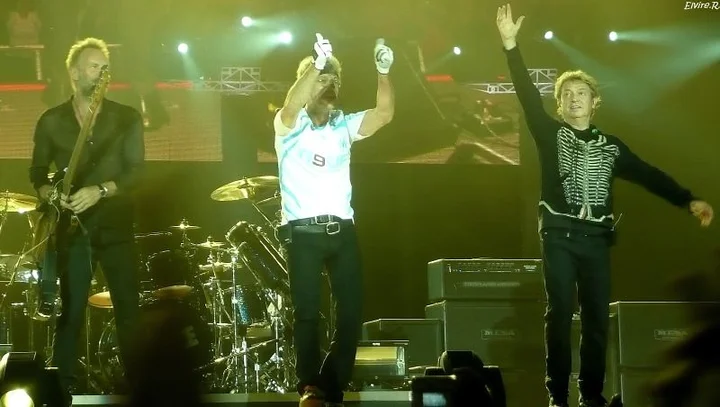 Photo: Elvire.R. / CC BY 2.0
· Madison Square Garden
 The PoliceNEW
The Police's last concert: Madison Square Garden, New York, August 7, 2008
Last song performed “Next to You”
· Nippon Budokan
 The Checkers
' last concert: the final night of FINAL TOUR at the Nippon Budokan, Tokyo, December 28, 1992
Last song performed “I Have a Dream”
- Active years (1969 – February 26, 1989)
- Debut single "Gunshū no Naka de / Hi wa Mata Noboru."
- Hitoshi Shimizu, Jiro Oma and Kazuhiko Matsuo officially join; the band becomes a five-piece.
- "Sayonara" released; it reaches No. 2 on Oricon, the band's first top-ten hit.
- Final night of ten at the Nippon Budokan closing the over tour; the five-piece's last concert.
- Yasuhiro Suzuki formally leaves.
- The band resumes as a four-piece with the single "Kimi ga, Uso o, Tsuita."
- Last album, Still a long way to go, released; a 102-show national tour opens the same day.
- Fan-club members are told of the breakup in a letter titled "To Our Friends."
- Last date of the tour, at the Nippon Budokan.
- Final show
- Photo book The Night with Us 1989.2.26 OFF COURSE FINAL published.
- Kazumasa Oda's first national tour as a solo artist.1 year later
- Oda's "Love Story wa Totsuzen ni" sells more than 2.7 million copies.2 years later
- Fan-voted best-of OFF COURSE BEST "ever" released.26 years later
- Oda is moved to tears singing "Kotoba ni Dekinai" at Tokyo Metropolitan Gymnasium, for the first time since the Tokyo Dome show, 27 years earlier (Re:minder).27 years later
- The June 30, 1982, Budokan concert is released on CD for the first time.33 years later
- Fourth Off Course Classics Concert at the Budokan, performed by guest singers.33 years later
- Oda, 77, begins the national tour Minna de Jiko Best!! (28 shows, 370,000 people).36 years later
- The 1982 NHK special on the band, Wakai Hiroba: Off Course no Sekai, airs on a cable channel for the first time.37 years later
Sources
27 sources
- 『若い広場 オフコースの世界』が必見な理由 幻の番組に刻まれた“美しいコーラス”の響き — Real Sound(大山くまお), March 5, 2026
- バイオグラフィー|オフコース — ユニバーサル ミュージック
- オフコースは今も心に ドラマー・大間ジローの思い — 神奈川新聞(カナロコ), December 29, 2015
- オフコース「さよなら」小田和正の運命を大きく変えた一曲 ~ 前篇 — Re:minder(宮木宣嗣), February 18, 2020
- オフコースの日本武道館10日間公演、日本ライブ史上に残るイベントの背景 — Re:minder(前田祥丈), June 30, 2022
- オフコース伝説の武道館コンサートから40年、初のライブCD化が決定 — ぴあ, April 8, 2022
- 「全体を見れていない俺っていうのも…」鈴木康博オフコース脱退とうらはらだった小田和正の“マイペースさ” — CREA(追分日出子『空と風と時と 小田和正の世界』より), December 31, 2023
- 小田和正の名曲「君住む街へ」を生んだオフコース1987年のツアー — Re:minder(宮木宣嗣), August 11, 2017
- ⑨オフコース『Still a long way to go』|『1234』につながる1988年邦楽アルバム — otonano(峯大貴), May 15, 2024
- STILL a long way to go|ツアー|小田和正公式 — 小田和正公式(FAR EAST CLUB)
- 小田和正「積極的に一人になったわけじゃないからね」と語るソロ活動への思いと270万枚の大ヒット曲『ラブ・ストーリーは突然に』の誕生秘話 — 集英社オンライン(小田和正『時は待ってくれない 「100年インタビュー」保存版』より), July 7, 2024
- 1989年02月03日 日本武道館|STILL a long way to go|小田和正公式 — 小田和正公式(FAR EAST CLUB)
- オフコース解散コンサート ~ 小田和正が再び歌えなくなったあの曲 — Re:minder(宮木宣嗣), February 26, 2019
- BOØWY、米米CLUB、X JAPAN、LUNA SEAからBiSHまで 東京ドームで迎えた伝説の解散/最終ライブ — Real Sound(市岡光子), November 2, 2023
- オフコース解散コンサート ~ 9年ぶりに歌われた「生まれ来る子供たちのために」 — Re:minder(宮木宣嗣), March 5, 2019
- 1989年02月26日 東京ドーム|OFF COURSE "The Night with Us"|小田和正公式 — 小田和正公式(FAR EAST CLUB)
- 小田和正が見せた涙。言葉にできない ~ 前篇 — Re:minder, September 20, 2020
- Three and Two / オフコース — OTOTOY
- オフコース・クラシックス — ユニバーサル ミュージック
- 小田和正 プロフィール — ソニーミュージック
- プロフィール|小田和正公式 — 小田和正公式(FAR EAST CLUB)
- 小田和正が見せた涙。言葉にできない ~ 後篇 — Re:minder(宮木宣嗣), November 4, 2016
- オフコース45年 ファン投票で生まれたベスト盤 16日に発売 — 神奈川新聞(カナロコ), December 4, 2015
- OFF COURSE BEST "ever" [SHM-CD] — ユニバーサル ミュージック
- 『オフコース・クラシックス・コンサート』、あの日と同じ日に日本武道館で4回目を開催 — THE FIRST TIMES(田中久勝), July 5, 2022
- Still a long way to go / オフコース(FHCL-3014) — 国立国会図書館サーチ
- オフコース @ 東京ドーム(1989/02/26) — LiveFans
Revision history
- Page created