Final in retrospectCarter Family Fold
Johnny Cash's last performance: the Carter Family Fold, Hiltons, Virginia, July 5, 2003
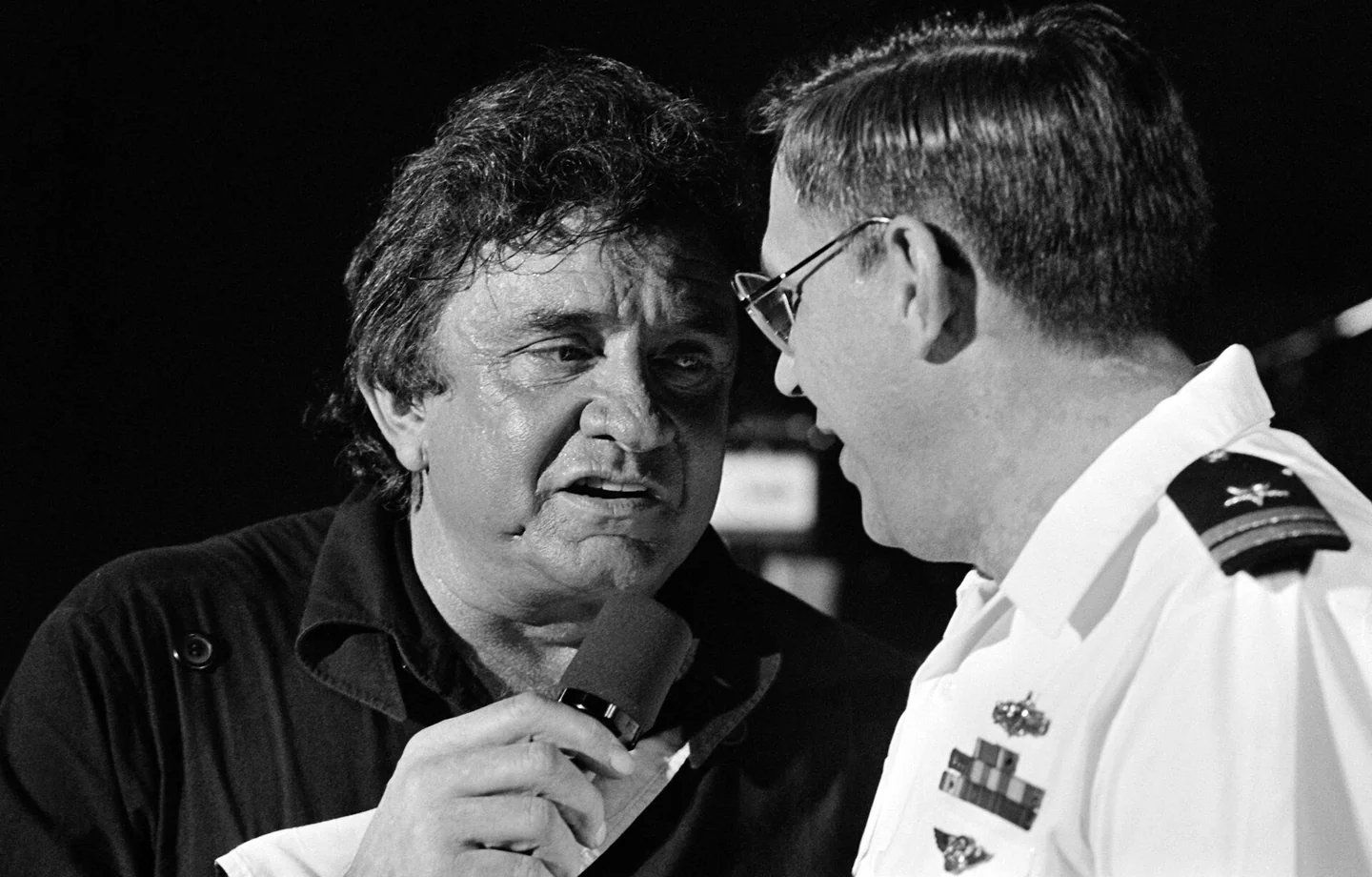
On the night of Saturday, July 5, 2003, at a music hall in the hills of southwest Virginia called the Carter Family Fold, Johnny Cash, 71, sat in a chair with a guitar and sang seven songs in about half an hour. His wife, June Carter Cash, had died less than two months earlier. The Fold stands on the land of her family, the Carter Family, and hosts old-time music shows every weekend; Cash's appearance that night was an unannounced surprise. He spoke about June before "Ring of Fire," and closed with "Understand Your Man," a 1964 hit he had not sung on stage in 25 years. It was Johnny Cash's last concert appearance, his final performance before an audience. The music video for "Hurt," often mistaken for his last performance, was filmed in October 2002 and was not a live show. Cash never sang in public again. He died on September 12, 2003, at 71.
Performance data
| Date | [2][3][15] |
|---|---|
| Venue | Carter Family Fold (Hiltons, Virginia) |
| Event | Saturday night show at the Carter Family Fold (unannounced appearance) [8][4] |
| Category | Final in retrospect |
| Why it ended | Death [2][17][4] |
| Lineup | Johnny Cash [8][2] |
| Last song performed | “Understand Your Man” [2][8] |
| Songs performed | 7 songsSee the setlist ↓ |
| Video release | No UnverifiedNo official video or audio of this performance has been found (November 2026). Rolling Stone's article embeds a YouTube video without stating its source. |
About the artist
J. R. Cash was born on February 26, 1932, in Kingsland, Arkansas. In 1935 the family moved to Dyess, Arkansas, where they worked the land. He finished high school in 1950, joined the Air Force, served in Germany, and was discharged in 1954.[1]
In 1955 Sun Records in Memphis released his first records, "Hey Porter" and "Cry, Cry, Cry"; it was Sun's Sam Phillips who named him Johnny. "I Walk the Line" reached No. 2 on the country chart in 1956. After moving to Columbia, he topped the country chart in 1963 with "Ring of Fire,"[1] a song written by June Carter and Merle Kilgore.[2]
He married June Carter in 1968.[1] She was the daughter of Maybelle Carter,[3] who, with A.P. and Sara Carter, made up the original Carter Family, whose first recordings at the 1927 Bristol Sessions are credited with launching country music.[4] The same year he released At Folsom Prison,[5] and its follow-up, Johnny Cash at San Quentin (1969), went to No. 1 on both the country and pop charts. The Johnny Cash Show ran in prime time on ABC from 1969 to 1971. His 1975 autobiography, Man in Black, sold more than a million copies. In 1980 he became the youngest person ever elected to the Country Music Hall of Fame, and in 1992 he entered the Rock and Roll Hall of Fame.[1] Over four decades he recorded more than 1,500 songs, placed 48 singles on Billboard's pop charts and won 10 Grammys, including a lifetime achievement award.[6]
In 1994 he signed with producer Rick Rubin's American Recordings and released the album American Recordings.[1] The partnership lasted the final decade of his life and produced four albums while he was alive;[7] one of them, Unchained, won the Grammy for best country album in 1998.[6]
Why this was the last show
The July 5 appearance was not billed as a farewell. It was an unannounced surprise at one of the Fold's weekend shows.[8] Cash never sang in public again before he died, and the night came to be remembered as his last performance before an audience. Rolling Stone calls it his "final public performance,"[2] and a regional arts magazine dates his last concert at the Fold to July 5, 2003.[3]
By then Cash was no longer touring. Rick Rubin later said that losing the road had been a terrible blow to him, and that he needed work to keep going.[9] That work was recording. In 2002 Cash recorded Nine Inch Nails' "Hurt" in Rubin's living room, with Benmont Tench adding organ and piano.[10] Trent Reznor had written the song and closed his band's 1994 album The Downward Spiral with it; Rubin was the one who brought it to Cash. Cash's version appeared on his 2002 album American IV: The Man Comes Around.[11]
People searching for Johnny Cash's "last performance" often land on the "Hurt" video, but it was not a concert. It was shot on October 18, 2002, by director Mark Romanek, at Cash's home on Old Hickory Lake in Hendersonville, Tennessee, and at the shuttered House of Cash museum nearby.[11] Romanek, a longtime fan, had asked Rubin to let him direct it and offered to work for free. The video mixed old footage of Cash riding trains and playing for prisoners with new footage of him at home at 70, and by February 2003 it was already airing on VH1 and MTV2.[12] The shoot took place eight and a half months before his final show.
June Carter Cash died on May 15, 2003, of complications from heart surgery.[1] According to Rubin, Cash asked the next day to keep working. Rubin set up a studio in a bedroom of Cash's Tennessee home and kept an engineer on call for most of the rest of his life. Sessions were booked every day, and Cash decided each morning whether he was up to recording.[9]
On Saturday, June 21, a little over five weeks after June's death, Cash appeared on the Fold's stage. Kimberly Burge of Sojourners reported that about 1,600 people came to a hall that usually held around 800, paying $5 a ticket. Cash came in with his son, John Carter Cash, and others at his side, and sang "Folsom Prison Blues" and "Sunday Mornin' Comin' Down." He dedicated a song to June, saying he didn't really know how to describe how he felt being up there without her.[13]
Two weeks later, on July 5, he came back to the same stage. It would be the last time.
What is known about the day
The Carter Family Fold sits on Carter family land in Poor Valley, at the foot of Clinch Mountain in Scott County, Virginia. Janette Carter, A.P. Carter's daughter, founded it in 1974; the building went up in 1976 and opened in 1979, and today it seats more than 800.[4] The shows began as Saturday performances at A.P. Carter's store.[3] The hall is open on three sides under a tin roof. The seating is old school-bus seats and wooden benches covered with carpet remnants, and overflow crowds sit on the grassy slope of the mountain.[13] There is no air conditioning, and no alcohol.[8] The Fold had a rule against electric instruments, but it was often set aside for Cash.[3] He and June had been playing there, usually without any publicity, since the late 1970s.[8]
July 5 was also a Saturday night. Wayne Robbins, who was in the audience and recorded the show on his own equipment, remembered hot July mountain air, a full grass parking lot and a crowded hall. Admission was $5, for a blue raffle ticket marked "Keep This Ticket."[8] No source found gives an attendance figure for the night.
Janette Carter opened the show by welcoming the crowd to the old-time music show and telling them they had a surprise coming. Cash took a seat on stage and was handed an acoustic guitar. With him were guitarist Jerry Hensley, June's cousin and a longtime member of Cash's band, and bassist Bobby Starnes of Jonesborough.[8] Behind him sat Janette and her brother Joe Carter, who had founded the Fold with her.[2]
Cash opened the way he always did, with "Hello, I'm Johnny Cash," and went into "Folsom Prison Blues." When he apologized for the hoarseness in his voice, someone in the crowd called out that he didn't have to play. "I don't? Okay," he said, and pretended to leave. When someone shouted that they loved him, he answered that he loved them too.[8]
He spoke about June before "Ring of Fire." The spirit of June Carter, he said, overshadowed him that night,[8] and she had come down from heaven to give him courage, as she always had. According to Rolling Stone, the crowd fell completely silent. He also recalled Janette once telling an audience that, when June met him, Johnny Cash was "already plugged in," a joke about the electric instruments on the stage.[2] He introduced "Ring of Fire" as a song June had written.[8] The Fold's own history page still notes that his set that night included "Ring of Fire," written by his late wife, and that he dedicated a song to the Carter Family.[4]
"I Walk the Line" came next, then "Sunday Mornin' Comin' Down," the Kris Kristofferson song Cash had first sung on his ABC show in 1970.[14] After that came "Angel Band," the hymn that had been sung at June's funeral, and "Big River."[8]
Cash introduced his last song as one he hadn't done on stage in 25 years.[8] It was "Understand Your Man," a 1964 single that spent six weeks at No. 1 on the country chart, with a melody that borrows from Bob Dylan's "Don't Think Twice, It's All Right." The whole set ran about 30 minutes.[2]
The song order here follows Robbins. Rolling Stone lists the same seven songs in a different order, with "Ring of Fire" fourth, and does not vouch for the order of the first three.[2] Both agree that "Understand Your Man" came last.
As Hensley and Starnes kept playing "I Walk the Line" as an instrumental, Cash left the stage and was driven away in a black Cadillac. He did not stay to sign autographs, and the show went on with the bluegrass band The Bluegrass Tradition.[8] The photographer Daniel Coston was also there that night; his photograph of Cash at the Fold is now part of the Southern Folklife Collection at the University of North Carolina at Chapel Hill.[15]
What the show left behind
Less than two months after the Fold show, the "Hurt" video won best cinematography at the MTV Video Music Awards on August 28, 2003.[16] Cash had planned to attend but was in the hospital and could not.[17] That night Justin Timberlake, accepting best male video for "Cry Me a River," dedicated the award to Cash, saying his grandfather had raised him on Johnny Cash.[16]
Johnny Cash died at 1 a.m. on September 12, 2003, at Baptist Hospital in Nashville, at 71; his manager, Lou Robin, said the cause was complications from diabetes, which resulted in respiratory failure.[17] He is buried near June at Hendersonville Memory Gardens in Tennessee.[1]
The honors for "Hurt" and its album continued after his death. American IV: The Man Comes Around was named album of the year at the 2003 Country Music Association Awards, and the video won the Grammy for best music video in 2004.[11] Romanek won both a Grammy and a CMA award for it.[10]
The recordings Cash kept making after June's death became posthumous albums. He left about 60 songs, and Rubin said he could not bring himself to face the tapes at first and left them in storage.[9] American V: A Hundred Highways, released in July 2006, debuted at No. 1 on the Billboard 200, Cash's first chart-topping album in 37 years, since Johnny Cash at San Quentin in 1969.[18] It includes "Like the 309," a train song and the last song he wrote.[9] A sixth volume, American VI: Ain't No Grave, followed in February 2010, timed to what would have been his 78th birthday.[7]
In 2005 the story of Johnny and June reached the screen in Walk the Line, directed by James Mangold, with Joaquin Phoenix as Cash and Reese Witherspoon as June. It opened in Japan on February 18, 2006, and Witherspoon won the Academy Award for best actress.[19] The boyhood home in Dyess where Cash grew up was bought by Arkansas State University in 2011, restored, and opened to the public as a museum on August 16, 2014.[1]
The Carter Family Fold still presents live music on weekends from February through November, under the direction of Janette's daughter, Rita Forrester.[4] Janette died in 2006.[3] The cabin where A.P. Carter was born now stands on the grounds; Marty Stuart led the effort to move it there in 2003, and it opened to the public in 2004.[20] Cash and June helped raise the money.[3] The Fold's website still records that Johnny Cash gave his final public performance inside its walls.[4]
No official video or audio of the July 5 show has been released. Rolling Stone's account embeds a video of the night from YouTube.[2]
Half an hour in a small music hall kept by his wife's family, a song she had written, and a song he had not sung on stage in 25 years: that was Johnny Cash's last show.
Setlist
7 songs [8][2]Main set Cover Last song
- Folsom Prison Blues
- Ring of Fire
- I Walk the Line
- Sunday Mornin' Comin' Down
- Angel Band
- Big River
- Understand Your Man
Another final curtain
More nights that no one knew would be the last.
· Yoyogi National Gymnasium
 Yutaka Ozaki
's last concert at Yoyogi National Gymnasium, October 30, 1991
Last song performed ダンスホール “Dansu Hōru”
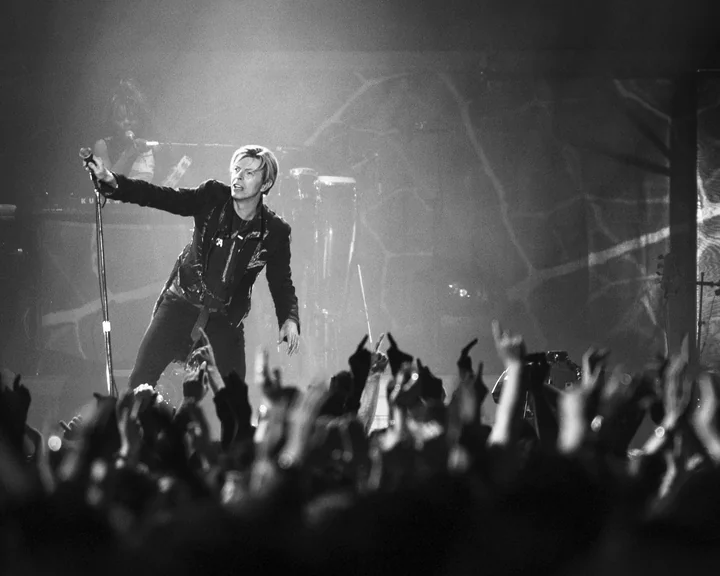 Photo: Roger Woolman / CC BY 3.0
· Eichenring
 David BowieNEW
David Bowie's last concert: Hurricane Festival, Scheeßel, June 25, 2004
Last song performed “Ziggy Stardust”
- Active years (1955 – July 5, 2003)
- Final show
- The "Hurt" video wins best cinematography at the MTV Video Music Awards. Cash, in the hospital, cannot attend.
- Dies at Baptist Hospital in Nashville, at 71.
- The "Hurt" video wins the Grammy for best music video.1 year later
- Walk the Line (2005), the film about Johnny and June, opens in Japan. Reese Witherspoon won the Academy Award for best actress.3 years later
- American V: A Hundred Highways, drawn from his final recordings, debuts at No. 1 on the Billboard 200, his first No. 1 album since At San Quentin in 1969.3 years later
- American VI: Ain't No Grave is released to mark what would have been his 78th birthday.7 years later
- His boyhood home in Dyess, Arkansas, opens as a museum run by Arkansas State University.11 years later
Related releasesPR
We may earn a commission if you buy through these links. Details
American IV: The Man Comes Around
The 2002 album discussed in the article (import CD), which includes "Hurt." It does not contain this performance.
At San Quentin(The Complete 1969 Concert)
The 1969 prison concert mentioned in the article (complete edition, import).
American Recordings
The 1994 first album of the series he made with Rick Rubin, mentioned in the article (import).
Sources
20 sources
- Johnny Cash (1932–2003) — CALS Encyclopedia of Arkansas (Eric Lensing)
- Flashback: See Johnny Cash's Final Public Performance — Rolling Stone (Stephen L. Betts; Rolling Stone Australia), 2016
- A Short History of the Carter Family Fold — A! Magazine for the Arts (Ben Jennings), February 26, 2024
- Heritage — Carter Family Fold
- ジョニー・キャッシュ カタログ — ソニーミュージック
- Country superstar Johnny Cash dies — UPI, September 12, 2003
- 'American' Remembered: Rick Rubin On Johnny Cash — NPR (Fresh Air), February 26, 2010
- Johnny Comes Home — Blue Ridge Outdoors (Wayne Robbins), September 1, 2008
- Work kept Johnny Cash going after wife died — TODAY (NBC News), July 2006
- "It really upset me and it really affected me": the story of Johnny Cash's haunting Hurt — Louder / Classic Rock (Bill DeMain), April 11, 2022
- 20 Years Ago Today: Johnny Cash Films the Video for "Hurt" — Saving Country Music, October 18, 2022
- Johnny Cash Makes 'Em Hurt — Rolling Stone, February 20, 2003
- Johnny Cash Goes Home — Sojourners (Kimberly Burge), January 2004
- Johnny Cash's 'Sunday Morning Coming Down': Flashback — Rolling Stone (Stephen L. Betts; Rolling Stone Australia), February 26, 2020
- Johnny Cash, last performance, July 5, 2003, Carter Family Fold, Hiltons, VA — Southern Folklife Collection, UNC-Chapel Hill Libraries
- Flashback: Johnny Cash's 'Hurt' Feels MTV Love — Rolling Stone
- The Man In Black Is Dead — CBS News / Associated Press, September 12, 2003
- Johnny Cash Posthumous Album Hits No. 1 — Associated Press (Fox News), July 12, 2006
- ウォーク・ザ・ライン 君につづく道 — 映画.com
- Maces Spring — The Historical Marker Database (HMDB)
Revision history
- Page created
 Michael Jackson