Not the end after allTokyo Dome
Kome Kome Club's farewell concert: The Last Symposium at Tokyo Dome, March 6, 1997
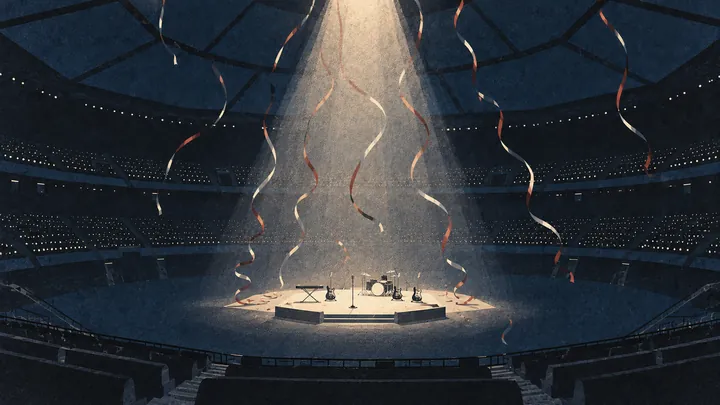
On March 6, 1997, at Tokyo Dome, Kome Kome Club played the second and final night of its farewell concert, "a K2C ENTERTAINMENT THE LAST SYMPOSIUM," and brought to a close a run that had begun with the band's formation in 1982. The breakup had been announced the previous November; tickets sold out on the day they went on sale, and the two nights drew close to 90,000 people. The stage preserved on the official video and live recordings opens with "Minna Yottoide," folds three of the band's biggest hits, "Hitosuji ni Narenai," "Kimi ga Iru Dake de" and "Roman Hikō," into a single medley, works through one-man skits and long stretches of talk, and ends with "Shake Hip!" Looking back years later, frontman Carl Smoky Ishii said that writing hits had become the band's top priority. But this was not the end after all. Nine years later, in April 2006, Kome Kome Club came back under the same name. A reunion meant to last six months simply kept going, and in 2025 the band toured for its 40th anniversary.
Performance data
| Date | [11][9] |
|---|---|
| Venue | Tokyo Dome (Tokyo) |
| Event | a K2C ENTERTAINMENT THE LAST SYMPOSIUM [9][10][11] |
| All dates | March 5, 1997, March 6, 1997 [11][9] |
| Category | Not the end after all |
| Why it ended | Breakup [5][11][8][13] |
| Lineup | Carl Smoky Ishii, James Onoda, Bon UnverifiedNo source names the members who played on March 6. Singers Ishii and Onoda and bassist Bon appear in the sources as members at the time of the breakup (Natalie; Real Sound), but their appearance on this night has not been confirmed. Other members at the time, such as Flash Kaneko and Minako, are not listed for the same reason. Japanese Wikipedia says Joplin Tokunō and Ryo-J, who left in 1995, took part; this has not been verified in a reliable source.[8][4][9] |
| Attendance | UnverifiedNo figure for this night alone has been found. Real Sound says the two nights drew close to 90,000 and sold out on the first day. For reference, Japanese Wikipedia gives 88,888 over two nights (44,444 each); not verified.[11] |
| Last song performed | UnverifiedFor reference: the last track of the official film (recorded at Tokyo Dome on March 5 and 6, 1997) is "Shake Hip!"; the product page does not say which night it comes from. Japanese Wikipedia also names "Shake Hip!" as the finale, without a citation. No official document or press report naming the last song of March 6 has been found.[9] |
| Songs performed | 31 songsSee the setlist ↓ |
| Video release | Yes [15][9][30][20] |
About the artist
Kome Kome Club was formed in 1982 by friends from a club at Bunka Gakuin, a private vocational school, among them Carl Smoky Ishii, James Onoda, Bon and Joplin Tokunō[1]. Bon, the band's leader, says the one thing he remembers for certain is that it was 1982[2][3]. The band made its major-label debut on October 21, 1985, with the single "I・CAN・BE" and the album Shari Sharism[1], produced by Satoshi Nakamura[4].
The music mixed funk, new wave, rock and mood kayō, the lounge-style pop of Japanese nightclubs. Writing for Real Sound, Fuyushogun names Talking Heads and Cabaret Voltaire as early influences and Kid Creole and the Coconuts and P-Funk as the band's core[4]. Ishii and Onoda shared lead vocals. On stage the band billed itself as an "entertainment show," with comedy sketches, skits and even rakugo-style storytelling, and made a point of never repeating the same show[4]. It was a big troupe: the in-house dance team Sue Cream Sue, which included Ishii's younger sister Minako, and the horn section Big Horns Bee[5][6]. Fuyushogun writes that the band was once dismissed as a novelty act but had the musicianship to be much more[4]. Ishii has said that when the band started, ordinary rock concerts bored him, so he set out to do something different[7].
The hits came from the late 1980s on. "Shake Hip!", the second single in April 1986, became a big hit when it was reissued in 1990, and "KOME KOME WAR" (1988) and "FUNK FUJIYAMA" (1989) also charted high[1]. "Roman Hikō," a track on the 1987 album KOMEGUNY, was released as the band's tenth single on April 8, 1990[4][1], used in Japan Airlines' summer Okinawa campaign, and became the group's first number-one single (in its eastern Japan edition) and first million-seller; THE FIRST TIMES gives total sales of 1.7 million, or 1.079 million by Oricon's count[1]. "Kimi ga Iru Dake de" (May 1992), the theme of the Fuji TV Monday-night drama Sugao no Mama de[1], sold 2.895 million copies[5].
Why this was thought to be the end
By the mid-1990s the band was changing shape. Guitarist Joplin Tokunō and drummer Ryo-J left in 1995, and the dance team Sue Cream Sue broke up in 1996. In November 1996, Kome Kome Club announced that it was breaking up[5]. The essayist Maho Shimao, a longtime fan, recalls that after the departures of the year before, she felt a breakup was unavoidable[6].
Ishii explained the decision in his own words in a 2017 interview with Natalie[8]. What had made Kome Kome Club fun, he said, was its habit of confounding the audience at every turn. But as a band from the subcultural fringe turned into a commercial act, it could not resist the pull toward hits, and writing hits became the top priority. At a meeting, Ishii asked the others whether Kome Kome Club had anything left to do, and the members agreed. He did not want to watch the band decline, he said; he wanted it to end while it was still in its glory[8].
Bon, the bassist, said in the same interview that a band cannot go on unless the members' feelings and energy match[8]. Both the breakup and the reunion, he added, were always Ishii's call, and the others followed[7].
The last stage was Tokyo Dome: two nights, March 5 and 6, 1997, under the title "a K2C ENTERTAINMENT THE LAST SYMPOSIUM"[9][10]. Tickets sold out on the first day, and the two nights drew close to 90,000 people[11]. Sony Music calls the shows the band's "last live"[9], and in 2023 Real Sound placed them among the farewell and final concerts held at the Dome, alongside Off Course, BOØWY, X JAPAN, LUNA SEA and THE YELLOW MONKEY[11].
The catalog was tidied up around the farewell. On March 31 came the singles collection HARVEST SINGLES 1985-1992 and a reissue of the debut album Shari Sharism, followed on June 1 by HARVEST SINGLES 1992-1997[12].
The shows turned out not to be the last. On April 1, 2006, nine years later, Kome Kome Club resumed activity under the same name[13]. This site files the final show of an act that later returns under the same name as "not the end after all." The name and the core members were the same, and the band was still touring for its 40th anniversary in 2025, so these nights go in that category[10][14].
What is known about the day
March 6 was the second of the two Tokyo Dome nights, and the last[9][11]. Nearly four months had passed since the breakup announcement. Tickets for both nights had sold out on the day they went on sale, and close to 90,000 people came in all[11]. No source was found for the size of this night's crowd alone, the weather or the starting time.
What happened on stage can be followed through the official film, released on video (two tapes) on June 21 that year[15] and on DVD for the first time on July 5, 2000[9]. Sony's product page lists the recording as Tokyo Dome, "March 5 and 6, 1997," and does not say which scenes come from which night[9]. The account below follows the running order of that film; whether it matches the order of March 6 exactly has not been confirmed.
The show opens with "Minna Yottoide" ("come on over, everyone"), followed by "Wandaburu Kaisan Di," a title with the word for breakup, kaisan, built into it[9]. After "Gokigen'yō! PARTY NIGHT" comes "BONUS SHOW TIME," a name that also turns up on the films of earlier tours[9][16]. In the "Takeuma POPS Medley," the three big hits of the 1990s, "Hitosuji ni Narenai," "Kimi ga Iru Dake de" and "Roman Hikō," are packed into a single medley[9].
The middle of the show runs through a "Sexy Medley" of "STYLISH WOMAN," "SO COOL" and "FOXY - Kiken na Koi," then "DEAD OR ALIVE," "Koi wa Mekimeki" and "Beautiful DX"[9]. The track titles of the live recording show what the film's list does not: "Hoteru Kuchibiru" and "Oi Oi Oi Madorosu-san" are each labeled "one-man play," and stretches of "MC," on-stage talk, follow songs such as "Ai Know Magic," "Nyū Sutairu" and "Puramu Jūsu"[17].
Later comes "J.O Tōjō no Tēma," a theme for the entrance of "J.O," then "Binetsu Shōnen" and "Dōmu Shinpo," whose title fuses "dome" and "symposium"[9]. J.O's entrance is a scene that appears again and again, in different forms, in the box set of live footage from 1985 to 1991[16]. "Special Love," which follows, is also on the singles collection HARVEST SINGLES 1992-1997[18]. The live recording also includes a track titled "Bonus Call ~ MC ~ Dancing All Night"[17].
Near the end, the "DANCE Medley Contest" stretches across four tracks of the film. Starting with "Ai wa Fushigi sa," it strings together singles from the band's twelve years since its debut, including the debut single "I・CAN・BE," "KOME KOME WAR," "FUNK FUJIYAMA" and "A Bura Kada Bura," before closing on "Katchoii!"[9].
The film then moves through "Just U" and "Child's days memory" and ends with "Shake Hip!"[9], the band's second single from 1986 that became a big hit on its reissue in 1990[1]. On the live recording, "Child's days memory" is framed by MC on both sides[17]. No official document or press report was found that names, for March 6 specifically, the last song the band played, so the data table lists the last song as not yet verified.
What the show left behind
The farewell was documented quickly. On June 21, 1997, the film a K2C ENTERTAINMENT THE LAST SYMPOSIUM came out on video, along with a second tape, THE BEST SYMPOSIUM, the same day[12][15]. The live album THE LAST SYMPOSIUM ~Kome Kome Club Last Live in Tokyo Dome~ followed on August 8[19]. The DVD arrived on July 5, 2000, as the second title in a reissue series[9], and the 2008 box set Komemori II collects footage up to the 1997 farewell concert[20].
The reunion grew out of Char's 50th birthday party, according to Flash Kaneko (Takahiro Kaneko), the band's saxophonist and keyboardist, who told Billboard JAPAN that the plan at first was a limited-time reunion[21]. Ishii recalls that after the band's 20th anniversary, fans began sending many letters asking Kome Kome Club to play again. The idea became to do it for just six months, and Ishii felt that if they did it, it had to be big and successful or there was no point[8].
On April 1, 2006, the band became active again for the first time in nine years. The first comeback single, "WELL COME 2," came out on July 19, with concerts set to begin at the end of September[13]. According to Real Sound, the reunited band had nine members: eight from what it calls the golden-era line-up, plus guitarist Be, who had been a support player[10]. When the six months were up, the band did not split again. Ishii said that announcing another breakup after half a year would have been childish, so they simply carried on[8]. In September 2007 came komedia.jp, the first original album in ten years, opening with "Roman Hikō '07"[22], and on New Year's Eve that year the band appeared on NHK's Kōhaku Uta Gassen[23].
The second life had its doubts too. In 2017 Ishii said that over time the band had come to feel it was going through the motions, drifting from what it had wanted to do, and that this led to a gap of four and a half years[7]. The all-time best-of LAST BEST ~Hōsaku Sanbu~, released on August 8 that year, was billed by Sony as "Kome Kome Club's last all-time best"[24]. That October the band appeared on NHK's music show SONGS for the first time in about ten years, playing an eleven-song medley, including "Kimi ga Iru Dake de," "Roman Hikō" and "Shake Hip!", for an audience of 400 fans[25].
A show from the band's last tour of the Heisei era, at Pacifico Yokohama on March 16, 2019, was also released on film, with "Kimi ga Iru Dake de," "Roman Hikō" and "Shake Hip!" in the set[26]. Two songs that had been folded into one medley in the 1997 farewell film stand there as songs of their own[9][26].
The songs have lived on outside the band as well. In 2022 "Roman Hikō" topped Spotify's list of the most-streamed songs released in the 1980s, and a tribute album built around it came out on August 9, 2023[1]; Real Sound notes that every track on it is "Roman Hikō"[11]. The same year, a cover of "Shake Hip!" by Mana and Kana of CHAI was used in a TV commercial for the Marugame Seimen udon chain[27].
For its 40th anniversary in 2025, Kome Kome Club played its first tour in two years, "Komekome Daikōgyō Ninjō Kamifubuki," from Omiya Sonic City on September 26 to Pia Arena MM on October 19[14], and on October 22 released Aikome ~FANtachy selection~, with 20 songs picked by fan vote and 20 by staff[14][28]. Speaking to Real Sound after the tour, Ishii said he thinks of Kome Kome Club not as a band giving concerts but as a show, and on the future, said simply that they would do it again when they felt like it[29][3].
The "symposium" that was supposed to end at Tokyo Dome in March 1997 picked up again nine years later, and it is still going more than forty years after the debut.
Context for readers
A band that was also a show. Kome Kome Club grew from a student club into a troupe with its own dancers and horn section[5]. Its concerts were built like variety shows, with skits and talk between songs, which is why the track lists of its live releases include items such as "one-man play" and "MC"[4][17].
Stage names. The members use playful stage names: Carl Smoky Ishii (real name Tatsuya Ishii)[10], James Onoda, Bon, Flash Kaneko and others. In this article the singer is called Ishii.
Japanese song titles. Most of the band's songs have Japanese titles that are puns or wordplay. They are given here in romanized form, with a gloss in the set list rather than an invented English title.
Two nights, one page. The farewell ran on March 5 and 6, 1997, at Tokyo Dome[9]. This page covers the second night, the last time the band played before the breakup. The official film draws on the two nights without saying which scenes come from which, so the set list below is the film's running order and is marked as not yet verified for March 6.
Watch / buyPR
We may earn a commission if you buy through these links. Details
a K2C ENTERTAINMENT THE LAST SYMPOSIUM
Two-disc DVD of the Tokyo Dome shows of March 5-6, 1997 (Sony Music). Billboard JAPAN's product page says the farewell concert is recorded complete and uncut, but neither page says which night it is or whether the nights are edited together, so whether it holds this night in full is unverified. Originally released on VHS on June 21, 1997 (SRVM-5570-5571). JAN 4988009106250 (Billboard JAPAN).
Setlist
31 songs Unverified[9][17]Main set Encore Last song
- みんなよっといで “Minna Yottoide” (come on over, everyone)
- ワンダブル解散でぃ “Wandaburu Kaisan Di” (wordplay on "wonderful" and "breakup day")
- ごきげんよう!PARTY NIGHT “Gokigen'yō! PARTY NIGHT” (good day! party night)
- BONUS SHOW TIME
- 愛Knowマジック “Ai Know Magic” (wordplay on "magic of love")
- 竹馬POPSメドレー~ひとすじになれない~君がいるだけで~浪漫飛行 “Takeuma POPS Medorē ~ Hitosuji ni Narenai ~ Kimi ga Iru Dake de ~ Roman Hikō” (stilts pops medley ~ I can't be single-minded ~ just because you're here ~ romantic flight)
- ホテルくちびる “Hoteru Kuchibiru” (hotel lips)
- ニュー・スタイル “Nyū Sutairu” (new style)
- セクシーメドレー~STYLISH WOMAN~SO COOL~FOXY-危険な恋 “Sekushī Medorē ~ STYLISH WOMAN ~ SO COOL ~ FOXY - Kiken na Koi” (sexy medley ... dangerous love)
- オイオイオイマドロスさん “Oi Oi Oi Madorosu-san” (hey, hey, hey, Mr. Sailor)
- DEAD OR ALIVE
- 恋はメキメキ “Koi wa Mekimeki” (love grows by leaps and bounds)
- Beautiful DX
- プラムジュース “Puramu Jūsu” (plum juice)
- ショックショック大ショック “Shokku Shokku Dai Shokku” (shock, shock, big shock)
- 愛してバタフライ “Aishite Batafurai” (love me, butterfly)
- J.O登場のテーマ “J.O Tōjō no Tēma” (theme for J.O's entrance)
- 美熱少年 “Binetsu Shōnen” (feverish boy)
- ドームシンポ “Dōmu Shinpo” (dome symposium)
- Special Love
- あ!あぶない! “A! Abunai!” (oh! look out!)
- 狂わせたいの “Kuruwasetai no” (I want to drive you crazy)
- 嫁津波 “Yome Tsunami” (bride tsunami)
- カナダからの手紙 “Kanada kara no Tegami” (a letter from Canada)
- ダンシング・オールナイト “Danshingu Ōru Naito” (dancing all night)
- DANCEメドレー大会~愛はふしぎさ~I・CAN・BE~あたいのレディーキラー “DANCE Medorē Taikai ~ Ai wa Fushigi sa ~ I・CAN・BE ~ Atai no Redī Kirā” (dance medley contest ~ love is a mystery ~ ... ~ my lady-killer)
- 抱きしめたい~じんじんさせて~sure danse~KOME KOME WAR~どうにもとまらない “Dakishimetai ~ Jinjin Sasete ~ sure danse ~ KOME KOME WAR ~ Dōnimo Tomaranai” (I want to hold you ~ make me tingle ~ ... ~ can't stop at all)
- なんですかこれは~なんでもいいんじゃないの~なんちゅうこと言うの “Nan desu ka Kore wa ~ Nan demo Iin ja nai no ~ Nanchū Koto Iu no” (what is this? ~ anything goes, doesn't it? ~ what are you saying?)
- FUNK FUJIYAMA~ア・ブラ・カダ・ブラ~OH!米GOD!~Peeping Tom~かっちょいい! “FUNK FUJIYAMA ~ A Bura Kada Bura ~ OH! Kome GOD! ~ Peeping Tom ~ Katchoii!” (... ~ abracadabra ~ oh! rice god! ~ ... ~ so cool!)
- Just U
- Child's days memory
- Shake Hip!
Another final curtain
More “last” shows that turned out not to be the last.
 Led Zeppelin
 X JAPAN
- Active years (1982 – March 6, 1997)
- Major-label debut with the single "I・CAN・BE" and the album Shari Sharism.
- "Roman Hikō" released as a single; the band's first number one (eastern Japan edition) and first million-seller.
- "Kimi ga Iru Dake de" released, the theme of the drama Sugao no Mama de; 2.895 million sold.
- Joplin Tokunō (guitar) and Ryo-J (drums) leave.
- Breakup announced.
- First night of the farewell concert at Tokyo Dome.
- Final show
- The film of the farewell concert released on VHS.
- Live album THE LAST SYMPOSIUM ~Kome Kome Club Last Live in Tokyo Dome~ released.
- The farewell film released on DVD for the first time.3 years later
- Resumes activity as Kome Kome Club after nine years; planned as a limited run, it continues.9 years later
- komedia.jp, the first original album in ten years.10 years later
- Appears on the 58th NHK Kōhaku Uta Gassen.10 years later
- All-time best-of LAST BEST ~Hōsaku Sanbu~ released.20 years later
- 40th-anniversary tour begins (through October 19).28 years later
- Aikome ~FANtachy selection~, chosen by fans and staff, released.28 years later
Sources
32 sources
- 米米CLUB「浪漫飛行」「君がいるだけで」など歌詞から名曲を味わう!世代を超えて愛され続けるバンドの魅力とは?最新情報も — THE FIRST TIMES(フジジュン), August 8, 2025
- 米米CLUB、シリアスなことも笑いで吹き飛ばしてきた40年 カールスモーキー石井&BONが追求するライブの美学(1ページ目) — Real Sound(榑林史章), December 12, 2025
- 米米CLUB、シリアスなことも笑いで吹き飛ばしてきた40年 カールスモーキー石井&BONが追求するライブの美学(3ページ目) — Real Sound(榑林史章), December 12, 2025
- 米米CLUBの功績を今こそ振り返る エンタメ性と音楽的探求はどう共存してきたか(1ページ目) — Real Sound(冬将軍), November 22, 2015
- 米米CLUBの功績を今こそ振り返る エンタメ性と音楽的探求はどう共存してきたか(2ページ目) — Real Sound(冬将軍), November 22, 2015
- しまおまほが語る米米CLUB(私と音楽 第13回) — 音楽ナタリー(佐野郷子)
- 米米CLUB「LAST BEST ~豊作参舞~」インタビュー|32年目の“遅咲き桜”が放つ 米米の真骨頂 — 音楽ナタリー(大山卓也), 2017
- 米米CLUB「LAST BEST ~豊作参舞~」インタビュー|32年目の“遅咲き桜”が放つ 米米の真骨頂 (2/2) — 音楽ナタリー(大山卓也), 2017
- a K2C ENTERTAINMENT THE LAST SYMPOSIUM(SRBL-1062~SRBL-1063) — ソニーミュージック
- 米米CLUBの功績を今こそ振り返る エンタメ性と音楽的探求はどう共存してきたか(3ページ目) — Real Sound(冬将軍), November 22, 2015
- BOØWY、米米CLUB、X JAPAN、LUNA SEAからBiSHまで 東京ドームで迎えた伝説の解散/最終ライブ — Real Sound(市岡光子), November 2, 2023
- 米米CLUB ディスコグラフィ(3ページ目) — ソニーミュージック
- WELL COME 2(SRCL-6392~SRCL-6393) — ソニーミュージック
- 米米CLUB、デビュー40周年記念ベストBOXリリース ファン投票やスタッフセレクトの計40曲収録 — Real Sound, July 17, 2025
- a K2C ENTERTAINMENT THE LAST SYMPOSIUM(SRVM-5570~SRVM-5571) — ソニーミュージック
- a K2C ENTERTAINMENT DVD BOX 米盛 I(SRBL-1301~SRBL-1312) — ソニーミュージック
- 音楽ダウンロード / 米米CLUB — ソニーミュージック
- HARVEST -SINGLES 1992-1997-(商品情報) — Billboard JAPAN
- これが最後!? 米米CLUB、“米米の日”にベストアルバムをリリース — Billboard JAPAN, June 30, 2017
- a K2C ENTERTAINMENT DVD BOX 米盛Ⅱ(SRBL-1351~SRBL-1362) — ソニーミュージック
- Flash金子×浅野孝已 スペシャル対談 — Billboard JAPAN(佐野郷子)
- komedia.jp(SRCL-6617) — ソニーミュージック
- 第58回NHK紅白歌合戦「歌力(うたぢから)」 — ザテレビジョン
- LAST BEST ~豊作参舞~【初回生産限定盤】(SRCL-30046~SRCL-30050) — ソニーミュージック
- 「SONGS」に10年ぶり米米CLUB、名曲から迷曲まで11曲メドレー — 音楽ナタリー, 2017
- a K2C ENTERTAINMENT TOUR 2019~おかわり~(SRBL-1857) — ソニーミュージック
- 米米CLUB「Shake Hip!」が丸亀製麺の新TVCMソングに決定! — ソニーミュージック, May 9, 2023
- 愛米 ~FANtachy selection~(SRCL-13420~SRCL-13422) — ソニーミュージック
- 米米CLUB、シリアスなことも笑いで吹き飛ばしてきた40年 カールスモーキー石井&BONが追求するライブの美学(2ページ目) — Real Sound(榑林史章), December 12, 2025
- a K2C ENTERTAINMENT THE LAST SYMPOSIUM(商品情報) — Billboard JAPAN
- LAST BEST ~豊作参舞~(SRCL-30051~SRCL-30053) — ソニーミュージック
- 米米CLUB/愛米 ~FANtachy selection~(商品情報) — 紀伊國屋書店
Revision history
- Page created